by Hakon Karlsen
A comprehensive explainer of climate sensitivity to CO2
by Javier Vinos
Over the past two decades, solar activity has been characterized by an extended solar minimum spanning two solar cycles, known as the Clilverd Minimum. This phenomenon is currently affecting the climate, but before we can understand its impact, we must address the significant discrepancy between the solar effects observed in paleoclimate proxy records and modern observations.
Posted in Uncategorized
by Jim Johnstone and Judith Curry
With the Atlantic hurricane season underway, we are closely monitoring the exceptionally warm SSTs in the Atlantic. This post describes what has been happening and why.
Posted in Uncategorized
by Judith Curry
My reflections on the Held v Montana Climate Lawsuit – the inside story, my written expert report and why I didn’t testify at the trial. Don’t believe the PR about this case from Our Children’s Trust, which the mainstream media has accepted uncritically.
Posted in Uncategorized
Posted in Uncategorized
by Joe Nalven
I recently published one article about how to incorporate an AI chatbot as part of a college course. I focused on lying, persuasion and self-reflection. I went even further and anticipated a White House comprehensive plan to counter antisemitism. I used a chatbot to develop my own version of what should be in that plan. Now, I am off on another adventure using a chatbot to understand the ins and outs of climate change impacts. And I need your help. You can see my inquiry as similar to the struggle to get computers, other electronic devices and software to be more user friendly — such as the improvements through GUIs (graphic user interfaces). Perhaps AUIs (algorithm user interfaces) would be helpful — especially if users can insert their own parameters (or “biases”) with a preset language formula.
Posted in Uncategorized
by Judith Curry
Clintel has published a new report entitled “The Frozen Climate Views of the IPCC: Analysis of the AR6.”
“The new Report provides an independent assessment of the most important parts of AR6. We document biases and errors in almost every chapter we reviewed. In some cases, of course, one can quibble endlessly about our criticism and how relevant it is for the overall ‘climate narrative’ of the IPCC. In some cases, though, we document such blatant cherry picking by the IPCC, that even ardent supporters of the IPCC should feel embarrassed.”
Posted in Uncategorized
by Planning Engineer (Russell Schussler)
Reflecting on the U.S. response to the covid pandemic, Dr. Fauci provides some important insights on managing complex risks – with relevance to climate change and the electric grid transition.
Posted in Uncategorized
by Planning Engineer (Russell Schussler)
There are many reasons why grid experts within the electric utility industry have not spoken out when unrealistic “green” goals were being developed and promoted over the last 20 years or so. A more open debate during this period might have helped provide a more realistic foundation for future development. This posting describes some reasons as to why at the corporate level electric utilities did not speak out more in defense of grid reliability. Collectively these factors tended to eliminate grid experts from playing any role in the development of policies impacting the grid.
Posted in Uncategorized
by David Young
Much has changed in science since the pandemic and much of it is change for the worse. The pandemic has highlighted the loss of credibility of the public health establishment and the often toxic nature of current public discourse. John Ioannidis stands out as perhaps the best example of a fine scientist who was smeared and denigrated mercilessly both online and in the literature. There was also a flood of fraudulent papers and badly flawed studies. This made claims that we should follow the “The Science” almost laughable, given the extremely poor quality of much of the science. The use of coercion was inexcusable when there was no rigorous basis for it.
Posted in Uncategorized
by Ross McKitrick
I recently published an op-ed in the Financial Post describing the findings of the new JGR paper by NOAA’s Zou et al. NOAA’s STAR series of the MSU satellite-based tropospheric temperatures used to show more warming than UAH or RSS in the mid-troposphere. Zhou et al. recently rebuilt their dataset and now STAR has a slightly lower trend than UAH. This is a big deal because it adds to the evidence that GCMs are warming too much compared to observations, which suggests problems with their climate sensitivity (ECS) values.
Posted in Uncategorized
by Planning Engineer (Russ Schussler)
“Green” ideas and their proponents can create problems. Like the antagonist in Terminator 2, green arguments and proponents don’t go down easily. With serious challenges, they retreat, hibernate sometimes, morph, transform and come back. It’s hard to argue with many “green” energy ideas. They are often huge in scope but severely limited in details. Focusing on a couple key factors and ignoring or leaving so much to be worked out later. Painfully naïve or unaware of so many factors associated with the provision of energy, feedback and often even human behavior. They see the flaws in current efforts, but are blind to the drawbacks which will necessarily emerge from their proposals. The offer conjectures with a lot of dots to still be connected. They speak of things that may be possible, without any handle on the probabilities.
Posted in Uncategorized
By Planning Engineer (Russ Schussler)
Do we care more about keeping CO2 emissions lower in just the western world, or do we want to reduce emissions worldwide?
Posted in Uncategorized
by Judith Curry
I have a new op-ed published in The Australian, here is the complete text.
Posted in Uncategorized
by Judith Curry
Last week’s Hearing was a sad example of what passes for debate and deliberations by the U.S. Senate. In any event, it provides an interesting case study of why the U.S. cannot bridge the partisan divide and figure out how to deal sensibly with the climate change issue.
Posted in Uncategorized
by Joachim Dengler and John Reid
A new way of looking at the the atmospheric carbon budget.
Posted in Uncategorized
by Judith Curry
The Hearing on “Risky Business: How Climate Change is Changing Insurance Markets” starts at 10 a.m.
Posted in Uncategorized
by Judith Curry
On March 22, I will be testifying before the Senate Budget Committee on the topic “Risky Business: How Climate Change is Changing Insurance Markets.”
Posted in Uncategorized
by Chris Morris and Planning Engineer (Russ Schussler)
Technically, what are wind and solar doing to South Australia’s grid? And why is South Australia’s electricity so expensive?
Posted in Uncategorized
by Judith Curry
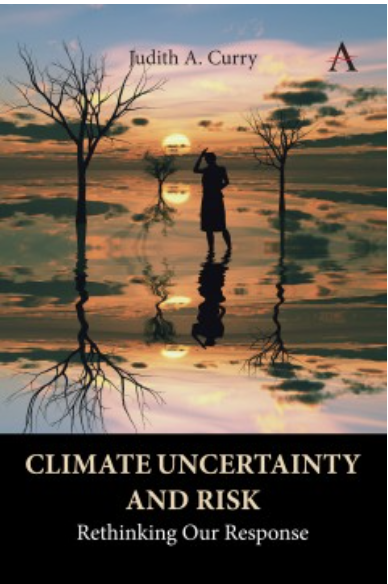
A preview of the contents of my forthcoming book Climate Uncertainty and Risk. Plus an update on the publication process and availability of the paperbook version for pre-orders.
Continue readingPosted in Uncategorized
by Planning Engineer (Russ Schussler) and Chris Morris
Many are looking towards Australia and seeing bold, innovative steps to increase the penetration levels of wind and solar resources. A grid revolution around the corner? Or just the madness of crowds? This post discusses what we can discern from their efforts so far.
Posted in Uncategorized
I imagine that I have been appointed the first CEO of a new agency set up by the Federal Government of the United States of America with the explicit goal of actually delivering a Net Zero CO2 Emissions Economy by 2050. My first task is to scope the project and to estimate the assets required to succeed. This is the result of that exercise, and includes a discussion of some consequences that flow from the scale and timescale for meeting the target.
Posted in Uncategorized
by Chris Morris & Planning Engineer (Russ Schussler)
What they are doing and what issues are occurring
Posted in Uncategorized