by Judith Curry
.
Of relevance to our discussion on the Tsonis et al papers and spatio-temporal chaos, there is a new paper out by David Douglass in Physics Letters, entitled “Topology of Earth’s climate indices and phase-locked state.”
.
Posted in Uncategorized
by Judith Curry
There has been much discussion in the climate blogosphere this past week on scientific story telling and communicating with the public.
Posted in Communication
by Tomas Milanovic
This post has been triggered by the following comment from Eli Rabbett in the spatio-temporal chaos thread :
Posted in Prediction
by Judith Curry
Motivated by a post by David Roberts at Grist, there has been some interesting reflection on Climategate this past week. Roberts’ post entitled “What we have and haven’t learned from Climategate” says:
Posted in Communication, Ethics, Uncertainty
by Judith Curry
I just spotted spotted an article on Reuters entitled “The Harry Potter Theory of Climate,” and I couldn’t resist doing a post on it.
Posted in Attribution
by Judith Curry
Schellenberger and Nordhaus of the Breakthrough Institute posted an interesting essay last week entitled “The Long Death of Environmentalism.” The summary reads:
Last week Breakthrough co-founders Michael Shellenberger and Ted Nordhaus returned to Yale University for a retrospective on their seminal 2004 essay, “The Death of Environmentalism.” In their speech they argued that the critical work of rethinking green politics was cut short by fantasies about green jobs and “An Inconvenient Truth.” The latter backfired — more Americans started to believe news of global warming was being exaggerated after the movie came out — the former made false promises that could not be realized by cap and trade. What is an earnest green who cares about global warming to do now? In this speech, Nordhaus and Shellenberger reflect on what went so badly awry, and offer 12 Theses for a post-environmental approach to climate change.
Posted in Policy
by Judith Curry
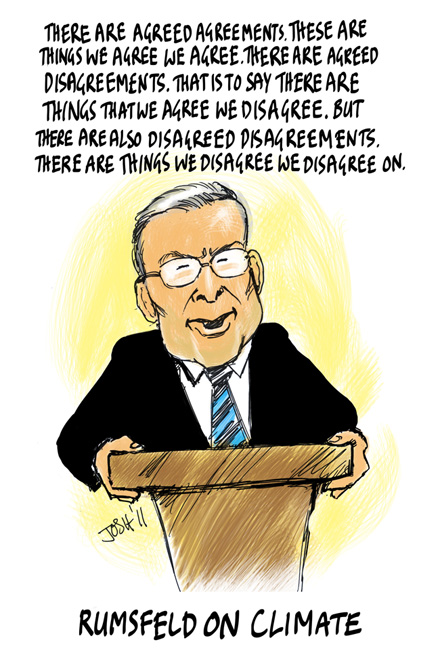
Part one has engendered considerable discussion. In addition to the discussion at the Blackboard, Roger Pielke Sr. has written an essay entitled “Missing the point of sensitivity” which is discussed at WUWT. Josh has prepared a cartoon:
Posted in Sociology of science
by Judith Curry
On Lucia Liljegren’s Blackboard (commonly categorized as a “lukewarmer” site), Zeke has a post titled “Agreeing.” Zeke’s motivation for this is:
My personal pet peeve in the climate debate is how much time is wasted on arguments that are largely spurious, while more substantive and interesting subjects receive short shrift. While I’m sure a number of folks will disagree with me on what is spurious vs. substantive, I think it would be useful to outline which parts of the debate I feel are relatively certain, are somewhat uncertain, and quite uncertain.
Posted in Sociology of science
by Judith Curry
The other threads are having problems with the reply threading, here is a new thread that will hopefully facilitate the discussion
Posted in Uncategorized
by Judith Curry
Continuing the themes of conflict prevention and best practices developed in Part III, I would like to discuss some pages from Edward Tufte’s book Beautiful Evidence, which was introduced here by Steve Mosher (seconded by MrPete). Of particular relevance is a chapter entitled “Corrupt Techniques in Evidence Presentations: Effects Without Cause, Cherry Picking, Punning, Chartjunk.”
Posted in Communication, Ethics, Scientific method
by Judith Curry
On the Part II thread, John Nielsen-Gammon summarized the constructive suggestions as follows. I’ve edited this to intersperse additional comments from John N-G and also Steve Mosher’s comments on these suggestions:
Posted in Uncategorized
by Judith Curry
The significance of the debate over the hockey stick and “hide the decline” is the following:
Posted in Data and observations, Ethics, Scientific method
by Judith Curry
To date, I’ve kept Climate Etc. a “tree ring free zone,” since the issues surrounding the hockey stick are a black hole for conflict and pretty much a tar baby, IMO. Further, paleoproxies are outside the arena of my personal research expertise, and I find my eyes glaze over when I start reading about bristlecones, etc. However, two things this week have changed my mind, and I have decided to take on one aspect of this issue: the infamous “hide the decline.”
Posted in Data and observations, Ethics
by Judith Curry
John Beddington, Chief Science Advisor to the UK government, goes to war against bad science (h/t BishopHill, dated Feb 14):
Posted in Scientific method
by Judith Curry
Over at WUWT, Jerome Ravetz has a guest post, which includes the text of his lecture at the public event in Lisbon, which is entitled “Nonviolence in science?”. I’ve excerpted what I regard as the more interesting points to serve as the focus for discusion.
Posted in Sociology of science
Posted in Communication, Scientific method
by Judith Curry
Rick Piltz at Climate Science Watch reports that the U.S. House of Representatives votes 244-179 to kill funding for the UN IPCC.
by Judith Curry
For the paper that I am writing on uncertainty and the IPCC, I am including a section on “Consensus, Disagreement, and Argument Justification.” While googling around on this this topic, I encountered a fascinating body of work by Princeton philosopher Thomas Kelly, which I find mind-blowingly relevant to the climate conflict. Here are some excerpts from a few of his papers that I found to be particularly provocative.
Posted in Scientific method
On the Uncertainty and the AR5 thread, Fred Moolten and Paul Dunmore provide starkly different arguments for reasoning about multiple lines of evidence. This issue gets to the heart of the source of much disagreement in the scientific debate about climate change.
Posted in Uncategorized
by Judith Curry
In Part I, I was very unconvinced by strategies for attributing extreme events to global warming. Today, two new papers have been published in Nature that attribute the recent heavy rains to global warming. For a summary, see this article linked to at Huffington Post. The article said:
Posted in Attribution
by Judith Curry
Part I addressed the mid-20th century surface temperature “bump” (peaking circa 1940). The IPCC AR4 states in the figure caption for FAQ3.1, Figure 1:
From about 1940 to 1970 the increasing industrialisation following World War II increased pollution in the Northern Hemisphere, contributing to cooling, and increases in carbon dioxide and other greenhouse gases dominate the observed warming after the mid-1970s.
Posted in Data and observations
by Judith Curry
Josh’s Valentine cartoon has the caption “Share the Love, Man” with a valentine aimed at Lisbon. Almost three weeks after the Lisbon Workshop on Reconciliation, is anything new evident from the participants that is of relevance to reconciliation?
Posted in Sociology of science
by Terry Oldberg
copyright by Terry Oldberg 2011
As originally planned, this essay was to end after Part II. However, Dr. Curry has asked me to address the topic of logic and climatology in a Part III. By the following remarks I respond to her request.
I focus upon the methodologies of the pair of inquiries that were conducted by IPCC Working Group 1 (WG1) in reaching the conclusions, in its year 2007 report, that:
I address the question of whether these methodologies were logical.
Posted in Uncategorized
by Judith Curry
On the Chris Colose thread, Andy Lacis wrote:
So, like the tobacco companies before them, they have elected to muddy the waters by deliberately sowing misinformation to confuse and bamboozle the public understanding of what is happening with global climate.
Posted in Politics
by Judith Curry
I am currently digging into the treatment of uncertainty in the IPCC AR5, pursuant to Part I and the paper that I am writing for Climate Change.
Posted in Uncertainty