Category Archives: Sociology of science

BEST(?) PR

by Judith Curry

The Berkeley Earth Surface Temperature (BEST) project is giving us much to discuss.  A number people have criticized the BEST PR in terms of posting the papers before the peer review process has completed, issuing a press release, etc.

Continue reading

Changing minds

by Judith Curry

Fred Moolten poses the following challenge:

I would be interested in a post asking participants how their own views have evolved as a result of participation here (and their experiences elsewhere as well). I expect few epiphanies or conversions, but I would be disappointed if no-one acknowledges learning anything. I’m sure you would be too.

Continue reading

Gender differences in the academic world: a reflection

by Don Aitkin

Our hostess ran a recent thread ‘On being a Radical scholar’, and she built it on article by Dr Kate Clancy, who wrote on the difficult situation of women who are doing their best to climb the academic ladder while also looking after children. I completely sympathised with her, and could identify with the stories that she heard at the Purdue conference that had prompted her essay.

Continue reading

IPCC discussion thread

by Tony Brown

Posts in the thread on uncertainty guidance for the IPCC have raised a basic question regarding the credibility of the IPCC as the world’s foremost source of information on climate, and hence its future relevance.

Continue reading

Who’s anti-science?

by Judith Curry

A blogospheric debate has erupted this weekend over who is more anti-science: the political right, or the left.

Continue reading

On torturing data

by Judith Curry

although very few researchers will go as far as to make up their own data, many will “torture the data until they confess”, and forget to mention that the results were obtained by torture….

Continue reading

Meta-expertise

by Judith Curry

How can we cope with becoming more hyper-specialized and fragmented in our personal knowledge bases while at the same time being exposed to too much relevant formation on the internet for any of us to learn and process?

Michael Smithson provides a modest proposal for addressing this challenge: We should all become expert about experts and expertise. That is, we should develop meta-expertise.

Continue reading

Trying to put the Climategate genie back in the bottle

by Judith Curry

The viral “Climategate” has had a substantial impact on public perception of climate science and scientists.  Several strategies have been tried to put the Climategate genie back in the bottle, without much success.  An article by Peter Wood published in the Chronicle of Higher Education entitled “Climate Thuggery” describes one such strategy, which I don’t think is working too well.

Continue reading

Going viral

by Judith Curry

Climategate – where did this almost perfectly strategic — yet deeply unfortunate — catchphrase come from? Was the term the genius of a conservative think tank and industry-backed strategy or does evidence support an alternative explanation?

Continue reading

Polemics, Politics, and Problematizations

by Judith Curry

While working on my null hypothesis essay, I encountered this interview with Michel Foucault shortly before his death, entitled “Polemics, Politics, and Problemizations.

Continue reading

Freedom of Information

by Judith Curry

Some interesting issues this week regarding Freedom of Information (FOI), related to Michael Mann and the UVa and also some statements by Sir Paul Nurse, President of the Royal Society.

Continue reading

On admitting and correcting mistakes

by Judith Curry

Inside Higher Education (UK) has a lengthy article by Darrel Ince  entitled “Systems failure”, with the subtitle “A scandal involving clinical trials based on research that was riddled with errors shows that journals, institutions and individuals must raise their standards.”   An interview with Ince can be found here.  There is discussion of this on two threads at Bishop Hill (here and here).  The article and interview are very thought provoking, with relevance to the context of the climate debate.

Continue reading

Quote of the week

by Judith Curry

“Do not confuse science with scientists, expertise with experts, or intellect with intellectuals. Society is not anti-intellectual or anti-science, it is anti-intellectuals, opposed to the people who claim those credentials, and for excellent reasons. Even those who on any given issue make appeals to the authority of selected scientists or experts will discount or reject equivalent authority when it does not confirm cherished biases.”

Continue reading

Polyclimate

by Judith Curry

I am trying to germinate an idea on how to move forward on the climate debate.  Bear with me through this argument, and let me know what you think.

Continue reading

Hidden knowledge

by Judith Curry

I stumbled across this essay by Michael Nielsen entitled “Science Beyond Individual Understanding,” which I think is very relevant to the climate problem.

Continue reading

Scientists Often Pigeonholed by Political Debates

by Judith Curry

This post takes its title from the NPR interview with Richard Muller, Director of the Berkeley Earth Surface Temperature project.

Continue reading

Scholars and Scandals

by Judith Curry

Well I thought it was probably impossible at this point for someone to come up with a fresh perspective on Climategate.  A new article in Inside Higher Ed entitled “Scholars and Scandals” arguably fits the bill.  The article tackles the broader questions of:

What is the best course of action when scholars’ motives and research are attacked? How quickly should they respond? Who should vet such allegations — universities, disciplinary societies, or some other entity? If scholars move too hastily, do the risks of getting it wrong (or of being later disproven) outweigh the damage of letting allegations fester without rebuttal?

Continue reading

An essay on the current state of the climate change debate

by Don Aitkin

JC note:  this essay was prepared for a recent address at given at the Manning House, in Australia.

The debate tonight is about ‘anthropogenic global warming’, and it is a debate, not a one-sided exposition. The debate exists because many people say the matter is important, and it is plainly also most contentious. To understand why our government is going down the path that it has chosen, a carbon tax, while the USA is not doing so, we need to know more than simply the local  and American political contexts. What is ‘climate change’ all about? Why is there any debate at all? Why are people so divided about it? The answers to these questions involve different elements of history, politics, ideology, narrative, science, mathematics and statistics. You can get some handle on it by recognising that if the matter were quite straightforward we would be doing something else tonight. In my judgment it is not at all straightforward, and it is hardly getting any more so.

Continue reading

UK SciTech peer review inquiry

by Judith Curry

The UK House of Commons Select Committee on Science and Technology has launched an inquiry into peer review.

Continue reading

Agreeing(?): Part II

by Judith Curry

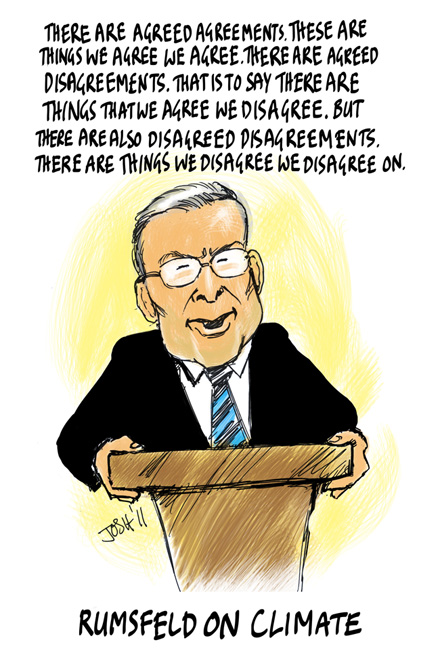
Part one has engendered considerable discussion.  In addition to the discussion at the Blackboard, Roger Pielke Sr. has written an essay entitled “Missing the point of sensitivity” which is discussed at WUWT.  Josh has prepared a cartoon:


Continue reading

Agreeing(?)

by Judith Curry

On Lucia Liljegren’s Blackboard (commonly categorized as a “lukewarmer” site), Zeke has a post titled “Agreeing.”    Zeke’s motivation for this is:

My personal pet peeve in the climate debate is how much time is wasted on arguments that are largely spurious, while more substantive and interesting subjects receive short shrift. While I’m sure a number of folks will disagree with me on what is spurious vs. substantive, I think it would be useful to outline which parts of the debate I feel are relatively certain, are somewhat uncertain, and quite uncertain.

Continue reading

Lisbon Workshop on Reconciliation. Part XII: Ravetz’s lecture

by Judith Curry

Over at WUWT, Jerome Ravetz has a guest post, which includes the text of his lecture at the public event in Lisbon, which is entitled “Nonviolence in science?”.  I’ve excerpted what I regard as the more interesting points to serve as the focus for discusion.

Continue reading

Lisbon Workshop on Reconciliation. Part XI: Convinced or Unconvinced?

by Judith Curry

Josh’s Valentine cartoon has the caption “Share the Love, Man” with a valentine aimed at Lisbon. Almost three weeks after the Lisbon Workshop on Reconciliation, is anything new evident from the participants that is of relevance to reconciliation?

Continue reading

Lisbon Workshop on Reconciliation. Part X: Alarmists vs Deniers

by Judith Curry

On Jan 28, a group of climate scientists supporting the IPCC consensus wrote a letter to members of the U.S. House of Representatives and Senators.

On Feb 8, a group of scientists skeptical of the IPCC consensus countered with their letter to members of the U.S. Congress.

Continue reading

Lisbon Workshop on Reconciliation. Part IX: Chris Colose’s Comment

by Judith Curry

Renewed attention (e.g. Tamino) is being given to Chris Colose’s comment that was originally posted on the thread Education versus Endocrination:

Continue reading