
by Javier Vinós
Alan Longhurst died last December 7th in the hospital of Figeac in Occitanie (France), where he had been admitted a few days earlier following a fall in nearby Cajarc, the small town where he lived.
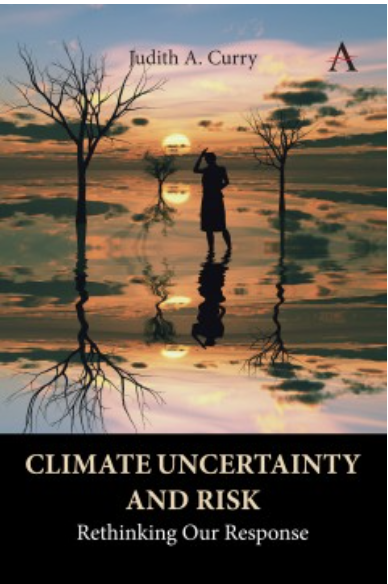
Alan has authored numerous posts at Climate Etc. and is also author of the book Doubt and Certainty in Climate Science.
He was born in Plymouth (United Kingdom) on March 5, 1925. He served his country at the end of World War II and was discharged in 1948. On his last assignment in Ethiopia, Alan fell in love with the lush wildlife of the savannah and decided to study zoology and ecology in London.
After completing his Ph.D., Alan returned to Africa in 1955 and began working in fisheries in Sierra Leone, which he continued five years later in Lagos, Nigeria, after a brief stay in New Zealand. A visit three years later from a representative of the U.S. Tuna Boat Owners Association changed his destiny. He told him that the Scripps Oceanographic Institute in La Jolla, California, was looking for someone like him to join their tuna oceanography group. Three months later, Alan was working in California. His wife, Françoise Bergeret, went with him. She was a graduate of the Institut d’études politiques de Paris and worked as an interpreter for the UN. They had met in Nigeria the previous year (1962) and traveled to La Jolla as newlyweds. Their children, Claire and Nicholas, later joined the family.
Alan found the scientific environment at Scripps very stimulating. His lab neighbor, Walter Munk , was studying the dynamics of tidal motion at the bottom of the ocean. It was in this environment that Alan first considered studying the vertical distribution of plankton in the course of the 1967-68 survey of the entire El Niño region coordinated by his institution, the US Bureau of Commercial Fisheries (now NOAA Fisheries), which after numerous cruises resulted in the 11-volume EASTROPAC Atlas. As director of the Southwest Fisheries Science Center, he coordinated the project. No one had studied the vertical distribution of plankton before, so Alan designed a new instrument to do so, the Longhurst-Hardy Plankton Recorder. This was one of his seminal contributions to marine biology.

When NOAA was formed in 1970, he was director of the La Jolla Laboratory of the Bureau of Commercial Fisheries, which was integrated with other West Coast laboratories and separated from Scripps. He was promoted to head NOAA operations from the California coast to Hawaii, an administrative position that took him away from the research he loved. So in 1971 he accepted a research position in his hometown of Plymouth, where the Longhurst family spent a few happy years in an old farmhouse on Dartmoor.
In 1977, Alan was recruited to the Bedford Institute of Oceanography in Nova Scotia, Canada, as Director of the Marine Ecology Laboratory. It was there that his career would culminate, as he became Director-General of the Institute from 1980-86 and continued to work there until his retirement in 1995. His other seminal contribution to oceanography came during these years. Alan had observed the importance of phytoplankton cycles and the conditions that drive them in ocean ecosystems. As a pioneer in the use of satellites to observe changes in plankton, he was able to demonstrate the existence of biogeochemical provinces in oceanic regions. His 1995 paper, the most cited in the Journal of Plankton Research, gave rise to the concept of the ecological geography of the sea, which led to a successful book of the same name in 1998 and a second edition in 2007. This book remains an essential study for understanding marine ecology.

Alan retired in 1995 and went to live with Françoise in Cajarc, where she opened a non-profit art gallery, Galerie l’Acadie, which exhibited works by local artists until it closed in early 2022. On December 22, 2022, Françoise died unexpectedly, leaving Alan completely devastated. It was the beginning of a phase in Alan’s life that he had not wished for. At the age of 98, he contemplated the end of his life without anxiety, waiting peacefully while looking at the sky of the South of France (le Midi) and occupying himself with everyday things, without forgetting the scientific questions that had always occupied him.
Alan Longhurst, the climate sceptic
His Wikipedia page, compiled by his friends at the Bedford Institute of Oceanography, barely mentions his climate scepticism, which is understandable given the scientific disrepute it currently carries. But Alan’s skepticism has been central to the last 26 years of his life, ever since his wife Françoise, trying to keep him from getting bored with the simple life in the French countryside, told him in 1997 that maybe he should start taking an interest in the climate issues that were making so many headlines.
Like me, Alan started from a position of confidence in the work of climate scientists. But he had the experience of virtually every year of oceanographic cruises that had taken him all over the world’s seas and oceans, and he had a deep understanding of the clear response of marine species to climate changes. In addition, Alan had a vast knowledge of the literature and studies of decades and centuries of ocean biology and conditions, including those conducted by the British Navy. One of his main complaints was that all this knowledge, obtained with great scientific rigor, was being completely ignored in the study of climate change, and that everything prior to the significant increase in our emissions was no longer ignored, but unknown to current scientists. He commented on how some of his published observations on the effects of nitrogen upwelling off the California coast on tuna populations had been republished as if they were new by a group in Northern California. He jokingly noted that a few months of research can often save a few hours at the library.
Such oceanographic and climate knowledge led him to a deep skepticism of the consensus proposed by the IPCC, which crystallized in several climate articles published on the Climate Etc. blog and in the writing of the book “Doubt and Certainty in Climate Science,” which took him several years to complete. Kip Hansen masterfully defined it in his review of the book as follows:
“Longhurst’s comprehension and recall of the details of hundreds of scientific papers from related and adjacent fields enter into this brilliant synopsis of the state of Climate Science – what doubts we still have and what, if any, certainty we can claim.”
However, the publishers of his oceanography books refused to publish a book that went against the prevailing climate dogma. This saddened Alan. If you have dedicated your life to science with honesty and integrity, it is not easy to deal with such rejection. It is an experience I share.
My first contact with Alan was in October, 2017. Not to be discouraged, Alan was working on a second edition of the book and wanted to use some figures I had made. It wasn’t until 2022 that he finally accepted that his book was unpublishable. I was in the process of publishing my first book, “Climate of the Past, Present and Future,” and offered to help him publish his. Alan enthusiastically accepted.
I began working on his book, helping him with text and figures, in early December, just weeks before Françoise’s unexpected death. Through our constant communication, I witnessed his most difficult months, when only the publication of his book and its positive reception brought him any joy. Gradually, Alan came to terms with what had happened, but it had hit him hard, and he complained about the immense task of dealing with the deceased’s unfinished business, legal and tax matters, and disposing of the large art collection that Françoise had accumulated, including a magnificent collection of African folk art that had been donated to a museum in Paris. He shared his home with a cat named “Cat” and still drove his little 40-year-old Peugeot, which he parked next to the cemetery wall, as if anticipating the end that is coming for us all. In one of his last messages in September, he said to me: “Javier, end of story – I am very lucky to be endig my life in this village… falcons nest on the cliff above the cemetery while our 40 year old car awaits its next passenger…”
His main scientific concern these days was the change he had noticed in the skies above Cajarc.

“Why, for instance, in southwest France for about two years now has the lower atmosphere suddenly become smog-particle free and the upper atmosphere devoid of water vapour? Why for more than a year now have the Sun and Moon risen and set in milk white brilliance every cloudless day or night? Why, in the same period, have I observed no towering cumulus clouds? And although air traffic overhead is near normal, where are the habitual N-S and E-W contrail grids of yesteryear?”
He was an old-fashioned scientist, based on observation and experimentation, from which hypotheses should emerge, not the other way around as happens in climate science. Therefore, his climate skepticism was intrinsic and not due to any conviction, but due to the lack of evidence to support the climate dogma and the abundant evidence of cyclical climate changes of natural origin, which by no means can stop working.
The last time I heard from him was in early November when I sent him a copy of my latest book, “Solving the Climate Puzzle.” His son told me he had it with him in the hospital. I will miss my friend Alan Longhurst and wish to join his children Claire, Nicholas and Maria and his grandchildren Liam, Olli, Bea and Emma in mourning his loss. Rest in peace.
JC note: I am very appreciative of this obituary written by Javier
500 million years ago during the Cambrian earth developed an explosion of plant and animal life. The had 18 times more CO2.
Why are we worried?.?
How many human beings lived there?
Has something to do with the rate of change. Where you are going, and how fast, is more important than where you are.
How do you know the rate of change is truly exceptional? Are you aware that Greenland experienced an abrupt 8-degree Celsius temperature increase within a few decades during Younger Dryas events?
Walter,
Yes I am aware of the rapid warming at the end of the Younger Dryas – as much as 10 C in a decade in Greenland, caused by a large release of fresh-water (Lake Agissaz) formed by the melting Laurentide ice sheet that interrupted the AMOC. I also know that it caused only a very small rise globally: less than 1C in the Northern Hemisphere, barely a blip in the Southern. I also know that the full glacial-interglacial transition took about 7,000 years with a global temperature rise of ~6 C (~ 1C/ thousand years); I also know this was sufficient to cause early Holocene extinctions. What I don’t know, is what it has to do with anthropogenic CO2 rise, which is currently causing (since 1981) temperature to rise ~0.18 C/decade, or 18 C/1000 years, for comparison with the G-IG transition. We can go into the CO2 increase and rates from the Tibetan Pots LIP, that caused the “great dying” 252 million years ago, if you like. Or the End-Botomian mass extinction around 517 million years ago, the Dresbachian extinction event about 502 million years ago, and the Cambrian–Ordovician extinction event 485 million years ago – you know around the time D. Hays thought there was as “explosion of life”.
https://www.nature.com/articles/s41586-021-03984-4 “Globally resolved surface temperatures since the Last Glacial Maximum”, PDF available at ResearchGate.
Mass Extinctions and Their Relationship With Atmospheric Carbon Dioxide Concentration: Implications for Earth’s Future (2023), https://agupubs.onlinelibrary.wiley.com/doi/full/10.1029/2022EF003336
https://www.climate.gov/news-features/understanding-climate/climate-change-global-temperature
“What I don’t know, is what it has to do with anthropogenic CO2 rise, which is currently causing (since 1981) temperature to rise ~0.18 C/decade, or 18 C/1000 years, for comparison with the G-IG transition.”
Well, if Earth is capable of causing such a dramatic change in Greenland, why wouldn’t it also be capable of generating changes that appear trivial in comparison to the monumental shifts witnessed by Greenland at the conclusion of the Younger Dryas?
Also I’m surprised you take the surface temperature estimates at face value (link below).
https://heartland.org/wp-content/uploads/documents/2022_Surface_Station_Report.pdf
Walter,
“Well, if Earth is capable of causing such a dramatic change in Greenland, why wouldn’t it also be capable of generating changes that appear trivial in comparison to the monumental shifts witnessed by Greenland at the conclusion of the Younger Dryas?”
Sure, anything is “possible” – just give some examples of that, and evidence of that is what is happening now.
I trust both satellite measurements and their agreement with ground station measurements, I also trust paleoclimatic measurements that are taken world-wide with multiple cross-correlated proxies. I also pay attention to scientific uncertainties associated with all those measurements, and determinations which come from different sources.
As for your “link” – I don’t doubt that there is bad siting of fixed surface stations. They also have uncertainties associated with them. It does not make them “corrupt”. As for the Heartland Institute – aren’t they the ones that “worked with tobacco company Philip Morris throughout the 1990s to attempt to discredit the health risks of secondhand smoke and lobby against smoking bans. Perhaps that is why the word “corrupt” comes to them so easily. No thanks, I don’t have enough time to read real peer reviewed science, much less anti-science activist propaganda garbage.
“which is currently causing (since 1981) temperature to rise ~0.18 C/decade, or 18 C/1000 years”
No, no. The shorter the period considered the larger the temperature change. Between January and July the Earth warms by 3.8 C. If extrapolated, those 0.6 C/month are 7,600 C/1000 years. But it doesn’t extrapolate because it is all cyclical, and those 0.6 C/month or 0.18 C/decade are nothing to be worried about. In about a century the world will be cooling whether we do something about current warming or not. That is as it has always has been and as it will always be.
“No, no. The shorter the period considered the larger the temperature change. Between January and July the Earth warms by 3.8 C. If extrapolated, those 0.6 C/month are 7,600 C/1000 years. But it doesn’t extrapolate because it is all cyclical, and those 0.6 C/month or 0.18 C/decade are nothing to be worried about. In about a century the world will be cooling whether we do something about current warming or not. That is as it has always has been and as it will always be.”
Earth’s warming has actually just accelerated. Earth’s energy imbalance is at a record high.
https://imgur.com/a/QFaA0lF
This was predicted. Thanks to a decrease in aerosols, GHG warming is being unmasked.
“Earth’s warming has actually just accelerated.”
Very likely the result of the Hunga Tonga eruption, as was predicted in Nature Climate Change last January
https://www.nature.com/articles/s41558-022-01568-2
Javier,
Formally correct, but stupid as usual. You are comparing a winter – summer seasonal differential with a 40-year decadal rate. You must be very desperate.
Javier,
HT is not the cause, because Earth’s Energy Imbalance is at a record high. That represents a change in the long term trend. HT is short term.
Specialists in one field are embarrassing in others.
Thank you
Except for climatologists. Experts in this field are an embarrassment to specialists in all others.
Javier
Totally agree. I have been appalled at some of the tribalistic and self serving behavior exhibited in the climate science field. Unfortunately, it has been inextricably entangled in the body politic and dragged down by the obsession with the preferred narrative.
I think that is more the case with non-climatologists that pretend to be.
cerescokid – look in the mirror.
I agree. They seem to not like people with different opinions. If one with relevant and impressive credentials were to come up with an alternative hypothesis other than GHG-dominant warming, wouldn’t the reaction to such a hypothesis be “hopefully yes”? Instead, you will be ostracized, with your livelihood being threatened.
Walter,
That’s a mighty big “if”.
ganon
I don’t need to look in the mirror. Let me explain the difference.
I’m not paid to uphold the ideals of the scientific method.
I’m not part of an institution that affects the well being of 8 billion people.
I’m not in academia which is supposed to be a role model for future climate scientists.
Or is that over your head?
Joethenonclimatescientist,
“Ganon – you would have a valid point if the activists did not get so much of the easy stuff wrong. Including pretending that pure speculation is solid science. An honest scientist would know the difference and demonstrate some respect – an activist would not”
I think activists on both sides get easy stuff wrong. When scientists get something wrong, they admit it and correct it with additional investigations. Other than that, I’m not sure what your point is. I have respect for people that study and understand the science, including those that understand it but have substantive points of skepticism that they can talk about intelligently. I have zero respect for people that think substanceless personal attacks are a valid refutation of anything, Unfortunately, that would have to include you.
cerescokid,
Not over my head. I am in the same position:
I’m not paid to uphold the ideals of the scientific method.
I’m not part of an institution that affects the well being of 8 billion people.
I’m not in academia which is supposed to be a role model for future climate scientists.
Nonetheless, I have respect for scientific integrity and do not have the same motivation to distort and misrepresent, as is apparent with you. Those are the differences.
ganon1950 | December 14, 2023 at 7:23 pm |
I think that is more the case with non-climatologists that pretend to be.
cerescokid – look in the mirror.
Ganon – you would have a valid point if the activists did not get so much of the easy stuff wrong. Including pretending that pure speculation is solid science. An honest scientist would know the difference and demonstrate some respect – an activist would not
A mirror for you is very appropriate.
It was my pleasure to have known Alan at the Bedford Institute and to have corresponded with him about his climate book. He was a great scientist and science adminstirator. I will miss him.
Thank you Javier for an interesting post.
Regards
Martin
A very nice remembrance. Thank you Javier.
Thanks, Javier for this post about Alan. By one of Alan’s articles on this website, I became interested in his person and I ever looked at Google where he lived. But visiting him never happened, so I am happy to read about him in your well-written story. It is a story I would like to advise to all people who are skeptical of skeptics just because those people are called a skeptic. “Truth-seekers” would be a better description. A description well fitting Alan.
Thank you, Javier. Well done.
“Doubt and Certainty in Climate Science” purchased just now, in hardcover. Who says you can’t buy Christmas presents for yourself? And thanks for the review.
Javier, I know we have disagreed on many things, but that was a most complete, compassionate, thorough, impressive, and light-filled way to honor the passing of your dear friend.
Very well done. My condolences on your loss.
w.
Scientific differences become personal differences only when those involved allow them to do so. Intellectual disagreement is perfectly compatible with a good relationship. The key is to confront the ideas, not the person.
Javier
“The key is to confront the ideas, not the person.”
One of the reasons I got interested in this issue was the constant personal attacks on skeptical scientists. Those attacking never refuted the science, they only engaged in ad hominem. I thought there must be a reason for that. There was.
cesescokid,
You funny, I responded to your dated, linear fit claim of only ~0.5 C warming with:
https://mega.nz/file/EmE3GTjC#oyp0jXeQHZNC_fWu9jnxX8kMMRKlwqY_C0RQX03PH9E
The exponetial fit is mathematically justified because prior to that, I demonstrated a statistically significant acceleration of temperature rise over the span of the instrumental record.
https://mega.nz/file/omdizYYK#14vzHFCUn6qgx2CEor3vcXNlt_RSld7t2QMHqAu1_nA
Except for an attack on the quality/uncertainty of the data in the early instrumental record (which was given in the second figure), not a peep in response to the science. But, plenty of personal attacks. How am I supposed to resond to that? Looks like you are one of those “Do as I say, not as I do” people.
ganon
Your comment then was so inconsequential and irrelevant to my point that I forgot where that discussion occurred. I went back and read my links. You misunderstood and still misunderstand the thrust of my material. I was questioning the pre 1900 data. But to add more context to the pre1900 data, I shared a paper that in part said even today there are uncertainties. That paper concluded that even with today’s improved technology and vastly superior coverage there was still significant uncertainty in the data for the newest trends.
Whatever you want to say the more recent trends are is fine with me. Pre1900 is what is in question.
I wonder what Dr. Longhurst thought of the decline of phytoplankton that has been going on for the last 100+ years.
And this has what to do with extra CO2 released by man?
Ocean warming and acidification.
https://www.nature.com/articles/nature09268
I can’t read that paper as it is behind a pay wall.
Javier,
Nobody understands climate change. For instance, the lower stratosphere stopped cooling in the 21st century, much to the surprise of scientists.
Thanks for that admission; however, you only speak for yourself – not others that do study and understand it.
The lower stratosphere has not stopped cooling, nor has the middle or upper. See (data sets TLS, and all C sets):
https://images.remss.com/msu/msu_time_series.html
Jim2,
The phytoplankton decline paper is available on ResearchGate for direct reading or as a PDF download. The paywall is not an excuse to not read it. Hint; if you search the article title followed by “PDF” they can usually be found, if not, there is often a link to make a direct request for (PDF) copy from the authors.
https://www.researchgate.net/publication/45424431_Global_phytoplankton_decline_over_the_past_century
Your phytoplankton paper considered mixing, wind, and sea surface temperature. They didn’t consider CO2 level and ocean acidification. They didn’t even mention the word and also didn’t mention pH. Try to be honest.
Jim2,
Gee, I’m sorry. I thought it was common knowledge that ocean acidification was bad for phytoplankton. Guess not for you. Here ya go:
https://nph.onlinelibrary.wiley.com/doi/10.1111/nph.17868
In particular, read the introduction and note all the references given.
ganon – It was YOU who said the Boyce paper blamed the alleged decline in phytoplankton on ocean acidification, not me. The paper does not say that anywhere. Stop Sealioning.
Jim2,
Don’t be stupid. This was the “conversation”:
JIm2: And this has what to do with extra CO2 released by man?
Ganon: Ocean warming and acidification.
I’m sorry if I didn’t give a complete bibliography for my answer. Both are true and you are nitpicking.
As a marine ecologist, Dr. Longhurst was well aware of what you ignore, that ocean productivity and land productivity have opposite trends related to temperature. Ocean productivity increases during cold periods because it is tied to ocean fertilization and upwelling and decreases during warm periods, while land productivity does the opposite. The blue whale, the largest animal known ever to have existed, is the result of the Late Cenozoic Ice Age, evolving from the Late Miocene.
So, 200+ years of warming should be accompanied of 200+ years of decreasing ocean productivity, and 200+ years of increasing land productivity. That is what is being observed. All of it natural.
Alan Longhurst was an expert on ocean productivity, having helped establish the link between plankton abundance and nitrate upwelling, iron fertilization, and the carbon cycle. If you want to know his opinions and his contributions you have his books and articles.
Javier,
Calling it anthropogenic doesn’t make it so.
That’s correct, a century of deeply tested science, says that it is so. Denying it doesn’t make it false.
Javier,
I don’t ignore it. The temperature is going up – it’s called anthropogenic climate change.
Javier,
So, 200+ years of warming should be accompanied of 200+ years of decreasing ocean productivity, and 200+ years of increasing land productivity. That is what is being observed. All of it natural.
No, the temperature rise is not natural. The increase in land productivity is largely due to artificial fertilization, irrigation, genetic modification, and mechanization. CO2 helps a little bit as long as the (unnatural) other fertilizations and water are provided.
If one is truly worried about AGW, and phytoplankton (highly questionable), then implement a low tech inverse solution countering “unnatural warming” by creating an “unnatural cooling” event; while giving the thumbs up to phytoplankton to boot.
ARTIFICIALLY SEED large swaths of the South Pacific Gyre, an oceanic desert having a footprint of 14 million square miles, with organics to create massive phytoplankton blooms. Relentlessly seed a predescribed area 24/7/365. Build a specialized fleet of supertankers to seed an overlaping GPS grid relentlessly, let’s say 2,000 supertankers, pick a number, do the math. I promise it will be cheaper than the trillions needed to get to net zero.
MEANWHILE, since risk is always a concern, cut off inputs at any time a looming ice age presents itself, or otherwise when the Left get cold feet after their pitiful charade reveals itself.
Governments aren’t serious about AGW, assuming the risks are real. The cost to implement a seeding program to sequester massive amounts of CO2 pales in comparison to the trillions needed to reach net zero emissions.
trunks,
I have a simpler and natural solution to “unnatural warming”: Transition away from burning fossil fuels for energy production.
To add, seeding large swaths of the Gyre will not only sequester CO2, but it will also marginally increase Earth’s albedo. The South Pacific Gyre has some of the darkest waters in the world. Phytoplankton will make seeded waters brighter. There’s a square mile equation to be arrived at, but this too would help to resolve a “cooling” equation.
Hmmm, how did the etymology of bird brain evolve?
Polly, your idea isn’t simpler, it’s massively more expensive. Squawk first, ankle bite, the questions later.
Karen: “it’s massively more expensive”.
I must have missed your analysis, also the cost estimate for damage done if my “simple solution” is ignored (it is also “trillions”).
“Transition away from burning fossil fuels for energy production.”
You ignore how that will delay getting electricity to those currently without it and harm them.
What amount will your plan change the CO2 growth curve? I believe it would only change it to a small amount. 1.3 billion without electricity today, and 2 billion more in population growth will mean CO2 grows for many decades.
Rob Starkey,
It’s pretty simple. For those that don’t have it and for expanded growth, provide that with non GHG technologies. Since costs are similar and renewables quicker to install, insisting that they use FFs would be depriving them, now and in the future. You make no sense, just emotional appeals that are not based in fact.
“Since costs are similar and renewables quicker to install, insisting that they use FFs would be depriving them, now and in the future.”
ganon–You are untruthful.
The costs are not similar. A coal fired plant is significantly less expensive for the 1.3 billion without electricity today (an understated number) and faster and simpler to install. Why do you believe China and India use coal?
Rob,
Sorry, I don’t pay very much attention to unsupported claims.
The costs are very similar.
https://www.eia.gov/outlooks/aeo/pdf/electricity_generation.pdf
China and India also use non GHG technologies and are growing while coal is declining (China down from 75% to 60% since 2010) India has been nearly constant at ~55%; Oil and Hydro down, with other renewables growing (substitute india for china in link below)
https://ourworldindata.org/energy/country/china
scroll down to chart:
Share of energy consumption by source, China
The real question is what direction should new builds go, considering cost, environmental damage, and future fuel availability. The answer is pretty obvious, whether you like it or not.
Regional Chinese authorities are responsible for developing their power systems, and they are cash-strapped, meaning they go for sort-term coal. National authorities have built the world’s largest sources of renewables on Earth.
For that molecule, it is released. Yeah, it will pass on that heat to i5t’s neighbors, and theoretically they will not melt until it is all at the same temperature Isn’t that what they told you in school?
Do you want to use Greenland for your example?
It is released by that molecule. I am not talking about Greenland.
“I must have missed your analysis, also the cost estimate for damage done if my “simple solution” is ignored (it is also “trillions”).”
Don’t be silly, Polly.
First of all, your so called “simple solution” isn’t simple. And you don’t need my analysis; experts have quantified costs to arrive at net zero goals, they’re in the multi-trillions. Net zero would bankrupt global cultures. So called “solutions” are already creating massive stresses, the U.S. doesn’t experience the 3x utility cost that Germany currently does, for example.
I have no issues with do no harm adaptation programs (thoughtful, organic programs). Technology is demonstrably advancing quickly. All the above energy; better agricultural techniques; better engineering; just being better stewards; common sense approaches.
But the costs to develop the type of sequestration program I described for the South Pacific Gyre wouldn’t nearly approach the trillions needed to get to net zero. It’s an alternative program countering warming head-on, it would supplant the need for net zero goals, and all incarnations.
The entire U.S. defense budget is $800 billion; relatively speaking, “seeding” as concept is extremely low tech, little R&D is required. Such a program would only require production/logistical issues to be map out. Certainly front-end loaded costs would be needed to develop a fleet, but costs would be shared among nations, and prorated over many years. After initial sunk program costs it becomes a maintenance issue. In comparison, the $800 billion U.S. defense budget recurs each and every year.
It defies logic that cheaper “solutions” aren’t seriously entertained if indeed CO2 is real—an entirely different question.
I haven’t seen a “levelized” cost of “green” energy that take into account backup power plants needed for when the sun doesn’t shine and the wind don’t blow.
jungletrunks, maybe you haven’t noticed – my solution is already 40% done in the US. And the last 20% is as high a priority.
Hi Jim, I agree there’s much ambiguity relative to estimates to arrive at net zero cost. If using CBO’s track record as an analogy for a track record of success, then calculate it will be 3x more than what experts predict.
Polly: “my solution is already 40% done in the US. And the last 20% is as high a priority.”
Unfortunately most don’t have wading boots high enough for your BS. You don’t have a clue—no need to wade through the newsprint beneath your perch.
I don’t care what they call it. Calling it anthropogenic doesn’t make it so.
Satellite measurements leave little doubt that the biosphere over land is expanding. Primary productivity is increasing. This is actually quite simple. The higher temperature and CO2 cause an increase in the flow of energy through all ecosystems. The result benefits most species. Plants produce more leaves and seeds, which support higher animal populations. In addition, warmer winters mean that more individuals survive the winter in mid and high latitudes.
The CO2 increase is a big boom in conservation. Too bad the money is being diverted to fighting climate change instead of wildlife conservation. This is the main reason I despise most conservation groups. By joining the climate parade they have shown that they are just money grabbers.
Money-grabbers? What part of climate change do you not umderstand?
I want to discuss it with you and we can start with the AMOC and go to Ocean Acidification and the deoxygenation of surface waters on land and sea.
“What part of climate change do you not umderstand?”
Nobody understands climate change. For instance, the lower stratosphere stopped cooling in the 21st century, much to the surprise of scientists.
https://agupubs.onlinelibrary.wiley.com/doi/abs/10.1029/2018JD028901
So I don’t think you can explain what you don’t understand.
Of course it stopped cooling being loaded with greenhouse gases.
“Of course it stopped cooling being loaded with greenhouse gases.”
How could you explain anything about climate change to anybody if you don’t even understand the simplest things? The cooling of the stratosphere is supposed to be one of the fingerprints of man-made global warming.
Do your homework before joining the grown-up climate discussions.
Crabby today? It won’t be the last day, since every day it gets hotter, as it would with greenhouse gases.
Why do you deny the effects of greenhouse gases?
@George J Kamburoff – look up Climate Doomer or Climate Alarmist in the dictionary and you will find his picture.
Oh boy, a discussion!
Let’s discuss the science, unless you can’t, then you will have to take personal shots at me.
“For instance, the lower stratosphere stopped cooling in the 21st century, much to the surprise of scientists.”
Unless they purposefully change the data to fit their narrative.
https://www.researchgate.net/publication/277779273_CLIMATE_CHANGE_Possible_artifacts_of_data_biases_in_the_recent_global_surface_warming_hiatus
Looks like the news on phytoplankton isn’t so bad after all.
These environmental changes over the last 20 years (1997–2018) have likely been positive in terms of environmental suitability for five broad groups of zooplankton: Oithona similis, Copepoda (Calanoida), Euphausiidae, Foraminifera, and Fritillaria spp. The changes are patchy geographically, with the highest improvement in the area between the Subantarctic Front and the southern boundary of the ACC. In contrast, the environmental conditions for pteropods have improved in the SAZ but worsened over the last 20 years over the Ross Sea shelf.
Unpicking what environmental changes are driving the predicted changes in the abundances of different zooplankton groups is difficult when using BRT models because the environmental drivers combine in complex ways. Briefly, for groups excepting pteropods, the main drivers of positive trends were increasing primary production (vgpm), increasing phytoplankton biomass (chl) and deepening mixed layer. Increasing frontal activity (sstgrad) contributed strongly to positive trends in Fritillaria spp. but had little effect on other groups. Changes to SST and sea-ice concentration had little effect on trends in environmental suitability for any of the broad groups of zooplankton. Future work will further explore the relative importances of environmental drivers on zooplankton.
https://www.sciencedirect.com/science/article/pii/S0967063720300911
Well, zooplankton aren’t phytoplankton, but still a little good news. Thanks.
Zooplankton eat phytoplankton, so the phytoplankton are probably doing fine also.
True, nice cover for your mistake. Do you copy and paste without reading?
ganon – it sure looks like you cherry picked a half-baked article that is 13 years old. Sampling of the ocean is sparse and is mostly northern hemisphere. Of the myriad of factors that affect turbidity and phytoplankton, they focused on only 3. Looks like a hastily put-together hit piece.
I don’t think you know what cherry picking means: taking information or data out of context (clipping or truncating). I simply gave a reference to the whole article, so that you could form your own opinion and do your own “hit job”.
Here are followups from the same authors:
https://aslopubs.onlinelibrary.wiley.com/doi/abs/10.4319/lom.2012.10.840
https://www.sciencedirect.com/science/article/abs/pii/S0079661114000135
as well as similar from other authors:
https://agupubs.onlinelibrary.wiley.com/doi/full/10.1002/2015GL066979
No ganon. Cherry picking is picking one or two examples of alleged “evidence” that back up your case while ignoring piles of other evidence that do not back up your case.
Pingback: Alan Longhurst 1925-2023: oceanographer and climate skeptic - Climate- Science.press
The temperature is going up – it’s called orbital forced climate change phenomenon.
–
https://www.cristos-vournas.com
No, the orbital forcing is going down (slowly) and has been for 8000 years (~ 0.2 C/thousand years). Over the last 100+ years, that cooling has been significantly outpaced by anthropogenic GHG warming.
Orbital forcing never goes down or up. Orbital changes are always taking place, slowly and constantly changing the distribution of the nearly constant solar radiation that reaches the top of the atmosphere. As a forcing is defined as a change in the radiative balance, orbital forcing is always present, albeit very small.
No, the temperature is going up – it’s called orbitally forced climate change phenomenon.
–
ganon,
“No, the orbital forcing is going down (slowly) and has been for 8000 years (~ 0.2 C/thousand years). Over the last 100+ years, that cooling has been significantly outpaced by anthropogenic GHG warming.”
–
“the orbital forcing is going down (slowly) and has been for 8000 years (~ 0.2 C/thousand years).”
–
ganon, your claim is already an oldscience.
–
There is not any anthropogenic GHG warming.
Christos,
Tested “old” science is much better than untested pseudo-science, for which you fail to give references (your blog doesn’t count).
Javier,
Orbital forcing never goes down or up.
The rest of your comment negates your opening statement. Of course, orbitally driven insolation forcing [change in insolation] goes up and down, and is a long-term driver of climate change. E.g., in the period from the LGM (~20 ky ago) until the Holocene maximum (~8 ky ago)the forcing was increasing; since then it has been decreasing. Note that the cycles of orbital forcing range from 20 ky to 400 ky, and do not have significant changes on the scale of a few hundred years.
ganon,
“Tested “old” science is much better than untested pseudo-science…”
–
The “anthropogenic GHG warming” is not a tested science.
It is untested pseudo-science…
–
There is not any anthropogenic GHG warming.
Because you say so?
I don’t think you understand the nature of orbital forcing and the changes in insolation caused by orbital changes. I suggest you read chapter 2 in my book “Climate of the Past, Present and Future. 2nd ed.” If you are too cheap for the three bucks it costs, you can get it for free at my ResearchGate page. Let nothing stand in the way of science!
why would we read your book when we have real numbers and citations from thousands of scientists?
George,
“when we have real numbers and citations from thousands of scientists?”
–
When?
Javier,
Why don’t you try reading some real books on (paleo) climatology, e.g.:
Paleoclimatology: From Snowball Earth to the Anthropocene
by Colin P. Summerhayes | Sep 8, 2020
Paleoclimatology: Reconstructing Climates of the Quaternary
by Raymond S. Bradley | Mar 6, 2014
Global Physical Climatology
by Dennis L. Hartmann | Jan 2, 2016
Biogeochemistry: An Analysis of Global Change
by W.H. Schlesinger and Emily S. Bernhardt | Sep 8, 2020
Instead of trying to pedal your book, particularly after you just admitted that you don’t understand climate science.
ganon
“ Why don’t you try reading some real books on (paleo) climatology, e.g.:”
So says the guy who has been investigating climate science for the astonishing time of 6 months to a scientist who spent years researching the issue and has written 2 books.
I thought Babylon Bee was hilarious but this is even funnier.
You are becoming a self parody.
cerescokid,
To quote you “The key is to confront the ideas, not the person.”
Now that is what I’d call self-parody.
PS ~ You don’t know how long I’ve been studying climatology. I have only said that I’ve been studying it seriously for six months, now eight. And that doesn’t say anything about how much I have been able to absorb and understand – clearly more than you, since all you do is make personal attacks and don’t respond to comments with scientific content. Keep it up – it’s entertaining.
ganon, I’ve read many paleoclimate books.
I had some discussions with Colin Summerhayes back in 2016 with him posting under the name of polarscientist. He gets many basic things wrong and his book is seriously misguided. Not worth it really.
Bradley’s book I’ve consulted. But I much prefer Thomas Crowley’s Paleoclymatology book.
Dennis Hartmann’s physical climatology is very good, but incomplete. For radiation stuff is one of the best around, but his treatment of heat transport is very poor. I would recommend David Randall, An Introduction to the Global Circulation of the Atmosphere. It’s outstanding.
The Biogeochemistry book I haven’t yet read.
For heat transport issues my books are much better than all those because it is a very neglected issue despite being one of the most fundamental features of climate and climate change. So the reading list is incomplete without my two books. The first at an academic level, like the ones in the list, and the second at a general readership level, because explaining complicated climate issues is not easy.
Javier,
“That statement has zero value.”
Yes, that describes your response.
“The delay in the climate response at the surface to a volcanic eruption is inconsequential as the stratospheric-tropospheric coupling is a slow process.”
Garbage – The climatic response to a volcanic injection happens almost entirely in the stratosphere. Coupling to the troposphere is only important for the decay of the effects though precipitation cleaning. Slow decay of a small amount of (relatively speaking) back into the atmosphere makes no climatic difference. Stratospheric effects of H-T should have begun within weeks in the Southern Hemisphere – they didn’t. There is also slow hemispheric exchange in the atmosphere (6-12 month rate constant); a NH response should have been delayed (and smaller) than the SH response. I have already shown that the warming occurred nearly simultaneously in the NH and SH, and stronger in the NH.
https://mega.nz/file/EncUkRqC#DXhcvLi1MeqeDoGXjee5kBhkWgn8iSrIdX7_Y_8yAjk
Also, that concurrent hemispheric warming “just happened” at the normal induction time (2-3 months) expected from the Nino 3.4 index crossing the “Nino threshold”.
https://www.climate.gov/news-features/blogs/enso/december-2023-el-nino-update-adventure
As usual, you talk a good game, but also show that you don’t really know what you are talking about. It seems yet another case of “illusory superiority” here, which you demonstarate over and over again.
T
Javier,
I disagree with you on the Summerhayes book – I like the historical approach and extensive, up-to-date referencing. I admit that it has some of the deficiencies of many single-author science books, but hardly “not worth it”. I’ll take a look at the Crowley and Randall books – thanks.
The global temperature anomaly has dropped to its lowest level since June.
https://climatlas.com/temperature/jra55/jra55_globe_t2m_recent_2023.png
Funny, HadCRUT 5.0.2.0, doesn’t agree. The November numbers just came out; here are the monthlies for 2023:
2023-01, 0.778
2023-02, 0.869
2023-03, 1.124
2023-04, 0.927
2023-05, 0.871
2023-06, 1.051
2023-07, 1.150
2023-08, 1.199
2023-09, 1.352
2023-10, 1.287
2023-11, 1.333
September and November are the highest anomalies on record, and it looks like 2023 will be the highest year on record.
Although it does not yet include November, see also:
https://svs.gsfc.nasa.gov/5191/
Little anklebiter,
Click on the link and you will see the state of the global temperature anomaly up to December 12.
Walter,
I clicked on it, it does not give enough information to determine which J55 data set is used. I simply pointed out that the accepted climatic GMST sources do not agree with the J55 weather reanalysis and forecasting system. If you don’t like it, and feel you have to resort to name-calling, that is your (very typical) problem.
NCEP’s Climate Forecast System Reanalysis (CFSR) shows the same thing. The peak anomaly induced by the Hunga Tonga eruption appears to have started its way down despite the still ongoing Niño.
https://oz4caster.wordpress.com/cfsr/
I think you read too much into the daily noise. Since it is now 2 years since Hunga Tonga erupted, it is better to see the trend in the 365-day running average (Same graph). Also, the last 6 months of warming, which only started 18 months after H-T, are more likely attributed to the current El Nino, which is (historically) expected to produce about 0.2 C of global warming through its duration – that is what is being observed.
https://www.carbonbrief.org/interactive-much-el-nino-affect-global-temperature/
“Also, the last 6 months of warming, which only started 18 months after H-T, are more likely attributed to the current El Nino, which is (historically) expected to produce about 0.2 C of global warming through its duration – that is what is being observed.”
The spike was observed starting in June or July, depending on the dataset you look at it. At the time, ONI was at 1.1, but the temperatures lag by 4 or so months when reflecting ENSO conditions. So that would mean an ONI index of just 0.2 was reflected at the time of the spike.
Walter, No, the ONI was 0.2 for Mar-Apr-May, and had risen to 1.1 for Jun-Jul-Aug, There is the 3 month lag from the onset. Since then, it has steadily increased to 1.8 for Sep-Oct-Nov. It looks very similar to the 1997-8 El Nino, and we should probably expect a few more strong months before it starts to tail off and return to the slower GHG growth curve.
https://origin.cpc.ncep.noaa.gov/products/analysis_monitoring/ensostuff/ONI_v5.php
He suggests that the warm anomaly originating from Hunga Tonga is gradually diminishing. While it’s true that, during El Niño episodes, the largest anomaly tends to manifest later than December, it appears that Hunga Tonga’s impact might be diminishing, potentially causing global temperature levels to revert to a strength comparable to a robust El Niño relative to the earlier 2015 baseline.
Maybe we’ll link back with the original 18 year pause. Wouldn’t that be a spectacle?
” the last 6 months of warming, which only started 18 months after H-T, are more likely attributed to the current El Nino”
That statement has zero value. The delay in the climate response at the surface to a volcanic eruption is inconsequential as the stratospheric-tropospheric coupling is a slow process. The Tambora eruption in April 1815 produced the Year Without a Summer in 1816, 15 months later. The warming from Hunga Tonga was predicted from the expected response to a strong increase in stratospheric water vapor. As the water vapor disappears from the stratosphere so will decrease the warming it caused at the surface. This is also in the article linked. This decrease should start a few months after the warming and proceed for a few years.
So we have a new cooling factor. The decrease in stratospheric water vapor. Don’t count on much warming for the next few years. As solar activity remains below average and goes even lower, and the AMO transitions to its cold state we can have net cooling for the rest of the decade. It will be interesting.
Another “green” solution, climate doomer FAIL!
At the beginning of last week, several bus services in Oslo were cancelled. The reason was that the new electric buses could not cope with the cold.
On Monday, about 50 city buses were cancelled and taken out of service. The bus company Ruter reported that the range of the electric buses was not as good as usual because of the cold weather. It was about 12 degrees below zero.
– The buses run out of power more quickly. We are now registering what happens day by day, and then we will see how we can improve this in the future, Cathrine Myhren-Haugen, communications manager at Ruter, told the Norwegian newspaper Nordre Aker Budstikke.
https://nordictimes.com/the-nordics/norway/electric-buses-could-not-withstand-the-cold-in-oslo/
ganon,
“Of course, orbitally driven insolation forcing [change in insolation] goes up and down, and is a long-term driver of climate change. E.g., in the period from the LGM (~20 ky ago) until the Holocene maximum (~8 ky ago)the forcing was increasing; since then it has been decreasing. Note that the cycles of orbital forcing range from 20 ky to 400 ky, and do not have significant changes on the scale of a few hundred years.”
–
Makes a lot of sense.
–
“Note that the cycles of orbital forcing range from 20 ky to 400 ky, and do not have significant changes on the scale of a few hundred years.”
–
Yes , they have significant changes in the case of Earth.
Earth has vast amounts of liquid water, part of it frozen in glaciers. There is a lot of “hidden” heat, when it is released a sudden vigorous warming occurs.
Yes, orbital forcing can be a tipping point “trigger” for nonlinear feedbacks and major transitions that take several thousand years, e.g., the transition from the LGM into the Holocene. But as I said, the orbital forcings (themselves) do not have significant changes on the scale of few hundred years. And as usual, you have things backwards; the melting of ice requires heat, it does not release it. An understanding of basic physical science is required before one can make intelligent commentary on complex science like climate change. Also, you should learn to provide supporting information for your (incorrect) proclamations.
ganon,
“the melting of ice requires heat, it does not release it.”
–
Of course, when the melting is closer to complete, the heat is released from going to the melting and is used on warming.
–
https://www.cristos-vournas.com
It releases heat from the first molecule.
The heat is not released, the cooling capacity has been exhausted. There is a difference.
Had CRUT may well post anomalies to a thousandth of a degree, but these are meaningless, given the level of accuracy of the individual measurements.
Actually, they give them to 7 or 8 significant figures. I am the one that rounded them to thousandths for easier visual interpretation They give the uncertainties, which for recent satellite measurements are on the order of 0.05 C (monthly) or 0.03 C (annual). It is standard practice to report values to 1 (or 2) places past the uncertainty to avoid significant round-off errors in subsequent calculations. That is what I have done. Hope that helps.
Actually it doesn’t. The fact that one the world’s leading measurement agencies would have the hubris to print the anomalies to 7 or 8 significant figures, given the basic limits of the accuracy of the original measurements raises huge doubts about their integrity.
Some of us recognize the limits due to measurement accuracy
Advocates will ignore it
Nice deflection Jay, first you complained about my numbers given to 0.001 C. I explained it, so you decided to attack something else.
Joe,
I reported with with the appropriate amount of significant figures, and I include uncertainties in my analyses. BTW the 0.05 and 0.03 C I quoted are two standard deviations, so you can divide by 2 if you like. Guess I must not be a biased advocate like you.
Don’t we witness the seasonal warming and cooling periods?
Aren’t they orbitally forced yearly cyclical phenomena?
–
https://www.cristos-vournas.com
Now we explain the mechanism by which a decrease in the amount of energy reaching the Northern Hemisphere warms the planet.
–
Pretty simple. Due to the tilt of the Earth, at certain parts of the orbit, the Northern Hemisphere cools while the rest warms. Since the rest has a lot more ocean, that warming is retained more easily.
–
Milankovitch made a mistake, because in his time he witnessed a gradual cooling.
–
Ice has specific heat 0,5 cal/(gr*oC)
Water has 1 cal/(gr*oC)
–
Thus, at the period of sea ice intense melting, the average air temperature dropped, the land glaciers started grow – and the planet experienced it as the LIA (Little Ice Age).
–
That period is over now.
–
https://www.cristos-vournas.com
With all due respect, ganon1950, I did not complain about your numbers given to 0.001. I merely asked a question. When you provided me with new information, I commented on it. Perhaps you should consider being less touchy.
Funny, I didn’t see any question – just a dismissal of HadCRUT data as “meaningless”. Of course, it has since become apparent that you had never even looked at a HadCRUT dataset.
@Javier @ganon1950
It is interesting that Javier quotes a paper that shows stratosphere is not cooling anymore whereas ganon gives dataset that clearly shows the 20-40km stratosphere is still cooling (20-40km is where most ozone is). Although ganon’s dataset shows the Lower stratosphere has stopped cooling.
So what’s the effect of ozone depleting substances on this?
why didnt the authors of Javiers study note that the 20-40 km stratosphere seems to have continued cooling, are there different datasets used?
Javier, would you acknowledge that if the 20-40km stratosphere continued cooling, this would not refute the enhanced GHG theory specifically re. this argument (notwithstanding any other potential fallacies as pointed out in your book)
Can we reconcile this gents, seems like a very important issue
PS / Almost finished reading your 2nd book Javier, kudos. Finally at least something that tries to synthesize all the work, both from the school of classic enhanced GHG theory to the school of (mostly paleooceanographers) “internal stochastic variability” school.
I have still lots of questions but will see if i can find the time to write them all up at some point.
MCB, thank you.
The temperature evolution in the stratosphere depends on altitude. Although there is a clear inflection point around 1997 at all altitudes, it is only in the lower stratosphere, MSU channel 4, where the temperature has completely stopped cooling.
https://agupubs.onlinelibrary.wiley.com/cms/asset/d90020e7-8123-4227-80db-4b15c783e76a/grl57484-fig-0001-m.jpg
It is a very important issue that shows we don’t understand what happens in the stratosphere, and therefore the idea that its temperature evolution is a fingerprint for AGW doesn’t hold water.
Global ozone stopped decreasing in 1993 and shows a little recovery since. Less than it was initially expected, but the expectations have been adjusted to match the timid recovery.
https://acp.copernicus.org/articles/22/6843/2022/
I would just like to point out that I gave a link to a site (RSS – Remote Sensing Systems) that provides up-to-date interactive graphing (and fit) of all data from the MSU and AMSU [(Advanced)Microwave Sounding Unit satellites], which provides temperatures for 11 different levels of the atmosphere, from ground level to 40 km. The one I referenced is the “TLS” (total lower stratosphere) dataset centered at 15 km. I chose this one because it is where Javier (falsely) claimed that lower stratospheric cooling had stopped after 2000. It is true, that the cooling has slowed somewhat, but it not a surprise to scientists (as Javier claimed). It is obvious when the mechanism is understood:
It is because the lower stratosphere is where the atmospheric column density above becomes both greater optical depth and lower molecular density. Thus, upwelling LWIR radiation (in CO2 absorption bands), has greater probability of being re-emitted into open space (cooling) and times between molecular collisions are greater (higher probability of re-emission rather than conversion of absorbed LWIR to heat via molecular collisions – less warming). The reason the lower stratosphere has slowed cooling is that increasing CO2 concentrations raise the elevation at which it transitions from being optically “thick” to optically “thin”, i.e., the ability to re-radiate to outer space is reduced. The transition can be easily seen in the RSS-MSU data sets: 15 km (TLS dataset) – cooling at -0.202 C/decade; 25 km (C11) -0.362 C/d; 40 km (C14) -0.761 C/d.
Here is the RSS-(A)MSU link again.
https://images.remss.com/msu/msu_time_series.html
PS ~ stratospheric ozone production is in a relatively tight altitude band from 20 km at the poles to 25 km at the equator. See figure 3 in:
https://amt.copernicus.org/articles/14/6407/2021/#&gid=1&pid=1
Note the “ozone hole” at high Southern latitudes for Sep-Oct-Nov. Note also that CO2 does not react with ozone or other photolytic free radicals (it is already fully oxidized), and thus has a very long atmospheric lifetime – a good thing or else it would be “snowball earth”, but there can be too much of a good thing, particularly if it is a large rapid change..
Javier,
Thank you for a fine essay.
ganon1950,
You have put up a lot of thought-provoking posts and links to data sets.
Thank you! That is my intent; unfortunately, I also have a bad habit of responding to various types of personal attacks.
ganon,
“Yes, orbital forcing can be a tipping point “trigger” for nonlinear feedbacks and major transitions that take several thousand years, e.g., the transition from the LGM into the Holocene. But as I said, the orbital forcings (themselves) do not have significant changes on the scale of few hundred years. And as usual, you have things backwards; the melting of ice requires heat, it does not release it. An understanding of basic physical science is required before one can make intelligent commentary on complex science like climate change. Also, you should learn to provide supporting information for your (incorrect) proclamations.”
–
“the orbital forcings (themselves) do not have significant changes on the scale of few hundred years.”
–
Yes they have, when sea ice melts to water. It is a phenomenon that is observed only on our planet Earth in the entire Solar System!
–
Also we are witnessing the orbital forcing in every years seasonal changes. If it was not for the ice melting to water, and then refreezing again, what the seasonal changes would have been about?
–
https://www.cristos-vournas.com
I’m sorry to learn of your loss of a friend and great scientist.
I’m grateful for your taking the time to document a biography of Alan Longhurst and reference his authorship.
Electric cars more likely to end up with an “upside-down” loan.
If you recently took out a loan to buy a car, especially a Tesla, you’ll likely be paying more for that car than it’s worth soon./i>
https://www.usatoday.com/story/money/personalfinance/2023/01/20/buyers-risk-car-loans-costs-rise-values-drop/11070649002/
This thread on Alan Longhurst (thanks to Javier) had me look up his biography in Wiki. From there to download his e-book ‘Doubt and certainty in climate science’.
Section 3.4 ‘The 1470-‐year Bond cycle and the glacial-‐interglacial transitions’. was thought provoking. Starting with the Bond cycle of 1470, that number is one and a half of the Eddy cycle. In fact the book say ” now termed Bond events by some, at intervals of 1470 ± 500 years throughout the Holocene”. The number 1470+/- 500 (490) makes it the Eddy cycle inflection points. The author in para 2 mentions specific dates when there were climatic anomalies.
Section 3.5 asks ” 3.5 -‐ Was there a role for CO2 in the orbitally-‐forced glaciations?” The short period of the anomalies intervals cannot be orbitally induced. Also it has already been said in papers past that obliquity is a main driver; eccentricity the least.
Unfortunately, Milankovitch survived, but J F Dodwell who pointed out a major obliquity switch in 2345bce has been completely ignored by science. 2345bce is an inflection point in the Eddy cycle, the cause of the 4k2 period major event.
The link below is based on Dodwell’s work, but re-worked by others. Dodwell’s 2345bce event is there but so is 173ce which he missed. The outlier dates were the most important of the 3000 year of measurement of obliquity.
https://melitamegalithic.wordpress.com/2022/10/31/searching-evidence-astronomy-for-the-heretic/
Thanks Javier, that was a great tribute and an interesting bio. Condolences on his passing, seems a very interesting, grounded, highly knowledgeable, science fellow.
ganon1950,
A considerate scientist would not have thread-bombed an obituary to a person more famous.
How aboput you take a break, revert to normal blog etiquette and promise to be civil in future?
Geoff S
Back atcha, Geoff. How about you not tell me what to do.
Javier,
I bet Allan would be rolling around laughing in delight over the debate that followed your Tribute! Fantastic; thoroughly enjoyed “it” (and the education) myself.
Pingback: Décès d’Alan Longhurst, océanographe et climato-sceptique – Le Point de Vue