by Judith Curry
A new paper by Polyakov, Kwok and Walsh is in press in the Bulletin of the American Meteorological Society, entitled: “Recent changes in arctic multi-year sea ice coverage and likely causes.” This is the best paper I’ve seen on this topic, which clearly articulates the complexity of the issue.
Recent changes in arctic multi-year sea ice coverage and likely causes
Igor V. Polyakov, Ronald Kwok, and John E. Walsh
The full paper is available online [here].
From the paper’s conclusions:
This article addresses probable causes of the observed reduction of the Arctic Ocean’s 179 coverage of MYI [multi-year ice] over that past decade. There is evidence of the increasingly important role 180 of atmospheric thermodynamic forcing in shaping recent changes of the Arctic MYI. In addition to direct MYI melt due to high-latitude warming, the impact of enhanced upper- ocean solar heating through numerous leads in decaying Arctic ice cover and consequent ice bottom melting has resulted in an accelerated rate of sea-ice retreat via a positive ice-albedo feedback mechanism. The pan-Arctic role of this feedback is yet to be quantified. Analysis of satellite ice motion suggests that the role of ice export through straits connecting the Arctic Ocean with sub-polar basins may be elusive. This situation probably differs from the situation that existed in the early to mid-1990s, when enhanced ice export through Fram Strait was caused by anomalous winds associated with the positive Arctic Oscillation phase. The possible long-lasting impact of anomalous winds such as those in 2004–05 or 2007 (especially when superimposed on a warming trend) on the state of MYI should not be ruled out. An intriguing feature of the scenario described here is the potential contribution of oceanic thermodynamic forcing to the recent changes of the high-latitude MYI coverage. Available observations suggest a thermodynamic coupling between the heat of the ocean interior and the sea ice. In the Canadian Basin, the impact of Pacific water warmth has been recently documented. While vertical AW [Atlantic Water] heat fluxes are negligible in the Canadian Basin, turbulent mixing may be strong enough in the western Nansen Basin to produce a sizable effect of AW heat on sea ice. In the eastern Eurasian Basin, double diffusion provides an important alternative to weak turbulent mixing for upward AW heat transport. However, this contribution to sea-ice loss remains uncertain pending new field experiments that will provide estimates of upward AW heat fluxes.
The fact that the rate of MYI recovery observed in recent years shows a delay relative to thermodynamic forcing indicates that MYI is resistant to recovery. However, the relative roles of dynamic and thermodynamic factors in recent changes of the Arctic MYI cover remains to be determined. Quantifying these roles is a high priority if we are to develop reliable forecasts of the future state of Arctic ice coverage.
JC comment: This paper clearly and authoritatively describes the complex interactions among ocean dynamics and heat transport, sea ice dynamics forced both by atmospheric winds and ocean currents, and atmospheric thermodynamic forcing in determining recent variations in multi-year sea ice extent. Hence sorting dynamical versus thermodynamic factors and attribution to increased greenhouse gases is not at all straightforward. Of more relevance than attribution is the development of reliable forecasts of the Arctic sea ice over the next few decades, which clearly requires consideration and integration of all these processes.
The Fat Lady has sung
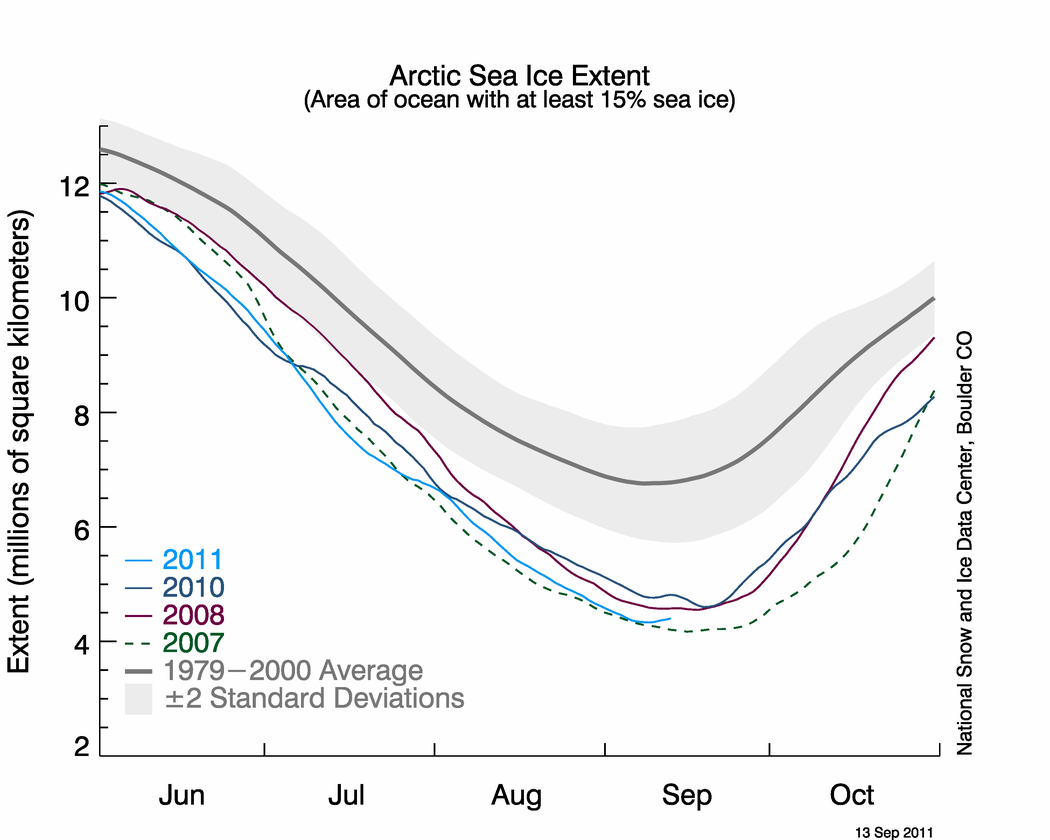
Neven has declared that the fat lady is singing in terms of having reached the minimum sea ice extent. NSIDC has the following announcement:
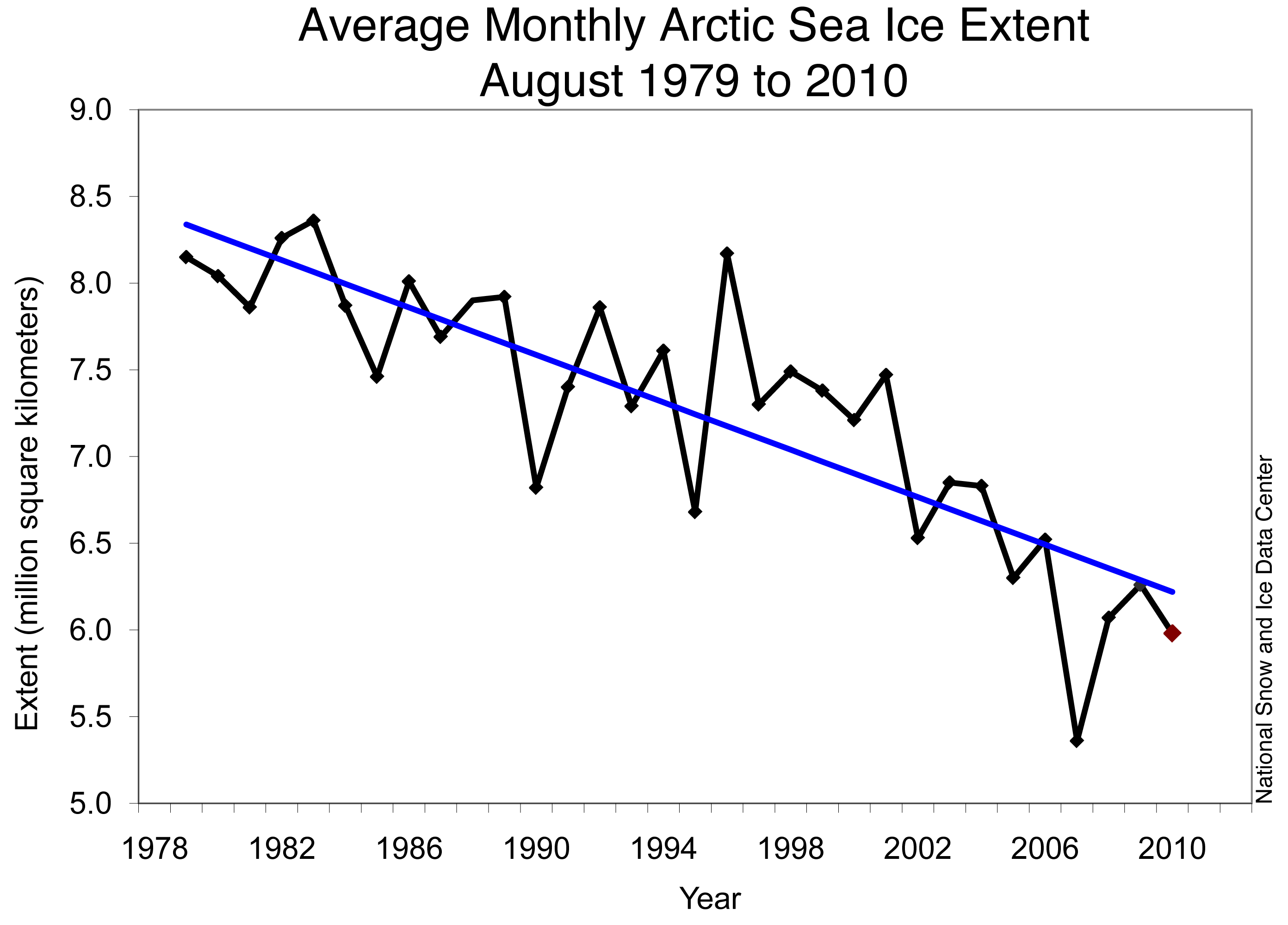
Arctic sea ice appears to have reached its lowest extent for the year. The minimum ice extent was the second lowest in the satellite record, after 2007, and continues the decadal trend of rapidly decreasing summer sea ice.
Please note that this is a preliminary announcement. Changing winds could still push ice flows together, reducing ice extent further. NSIDC scientists will release a full analysis of the melt season in early October, once monthly data are available for September.
What is relevant right now from my perspective is how rapidly the freeze-up will occur and with what spatial distribution; this is largely at the whim of weather patterns. The recent uptick in sea ice extent is intriguing. My research group has just submitted a paper for publication on the subject of autumn sea ice patterns as a precursor for wintertime snowfall and surface temperatures in the Northern Hemisphere.
New paper on the NCAR sea ice model
Improved sea ice shortwave radiation physics in CCSM4: The impact of melt ponds and aerosols on Arctic sea ice
Marika M. Holland, David A. Bailey, Bruce P. Briegleb, Bonnie Light, Elizabeth Hunke
Abstract. The Community Climate System Model, 4 has revisions across all components. For sea ice, the most notable improvements are the incorporation of a new shortwave radiative transfer scheme and the capabilities that this enables. This scheme uses inherent optical properties to define scattering and absorption characteristics of snow, ice and included shortwave absorbers and explicitly allows for melt ponds and aerosols. The deposition and cycling of aerosols in sea ice is now included and a new parameterization derives ponded water from the surface meltwater flux. Taken together, this provides a more sophisticated, accurate, and complete treatment of sea ice radiative transfer. In preindustrial CO2 simulations, the radiative impact of ponds and aerosols on Arctic sea ice is 1.1 W/m2 annually, with aerosols accounting for up to 8 W/m2 enhanced June shortwave absorption in the Barents/Kara Seas, and with ponds accounting for over 10 W/m2 in shelf regions in July. In 2XCO2 simulations with the same aerosol deposition, ponds have a larger effect whereas aerosol effects are reduced, thereby modifying the surface albedo feedback. While the direct forcing is modest, because aerosols and ponds influence the albedo, the response is amplified. In simulations with no ponds or aerosols in sea ice, the Arctic ice is over a meter thicker and retains more summer ice cover. Diagnosis of a 20th century simulation indicates an increased radiative forcing from aerosols and melt ponds, which could play a role in 20th century Arctic sea ice reductions. In contrast, ponds and aerosol deposition have little effect on Antarctic sea ice for all climates considered.






Leave a Reply