

by Rud Istvan
The crescendo of climate change ‘bad’ news leading up to release of problematic AR5 SPM continues.
For example, a new paper [1] from the University of East Anglia is upsetting according to its own UEA PR:
Climate change will upset vital ocean chemical cycles
Lead researcher Dr. Thomas Mock, said: “Phytoplankton, including micro-algae, are responsible for half of the carbon dioxide that is naturally removed from the atmosphere. As well as being vital to climate control, it also creates enough oxygen for every other breath we take, and forms the base of the food chain for fisheries so it is incredibly important for food security…Previous studies have shown that phytoplankton communities respond to global warming by changes in diversity and productivity. But with our study we show that warmer temperatures directly impact the chemical cycles in plankton, which has not been shown before.”
In just 24 hours this UEA PR headline was repeated many times, for example by NERC, ScienceDaily, and the Times of India. Often with little twists like:
Warming Oceans Could ‘Upset Natural Cycles’ And Kill Carbon-Storing Plankton; Would Lead To Vicious Cycle’ Of Climate Change
The paper’s abstract (below) shows this PR transmogrification is utter nonsense, the opposite of what the UEA paper actually found.
The IPCC maintains that CAGW will raise 2100 average surface temperature by 3.4°C (AR4) to 3.7°C (AR5 leaked FOD Table SPM.2 scenario RCP8.5). Phytoplankton only thrives in the upper mixed ocean layer (since sunlight only penetrates a few tens of meters into the ocean). The ocean mixed layer equilibrates with surface temperature because of, well, mixing.
There is no doubt that a +3.5 temperature rise beneficially affects cold water phytoplankton metabolism.[2] With even a moment’s thought about the real world, it is not credible that ‘climate change will upset vital ocean chemical cycles’ for the whole world. If conditions change phytoplankton just bloom elsewhere. For example…
The seasonal Atlantic swing along Fort Lauderdale beaches is from 71°F (brr) to 86°F, about Δ8°C. I should know, I have lived in a building located right on this beach for over a decade.
These shallow coastal waters contain one of the only coral reef systems along the continental US. It lies about 0.3km offshore from the beach, at depths of about 5-30 meters in 3 reef bands. You can just make them out by the second ocean color change (a little further out than the buildings are tall at that point). You can kayak/snorkel to them from the beach if you don’t scuba. This local ecosystem’s coastal phytoplankton are already adapted to more temperature variation than 3 something degrees. FLL phytoplankton thrives in summer heat. Shallow reef winter (brr) visibility is better than during summer’s maximum phytoplankton bloom. Just Mark I Eyeball dive observations…
This reef system only extends about 60 miles further north to Palm Beach. By Daytona Beach, the seasonal sea temperature swing is from 61°F (Brrrrrrrrrr) to 80°F, consistently ≥3°C lower than FLL throughout all seasons. As great a difference as IPCC’s prognosticated ≈3.5°C climate change by 2100. Any ‘overheated’ Fort Lauderdale phytoplankton could adapt by ‘moving’ to Daytona Beach–if the IPCC were right, which they probably aren’t.
Perhaps my perspective is unfair, since it is only about shallow coastal seas. What about the North Atlantic north of Florida? Here is a July surface temperature map for a portion of it.
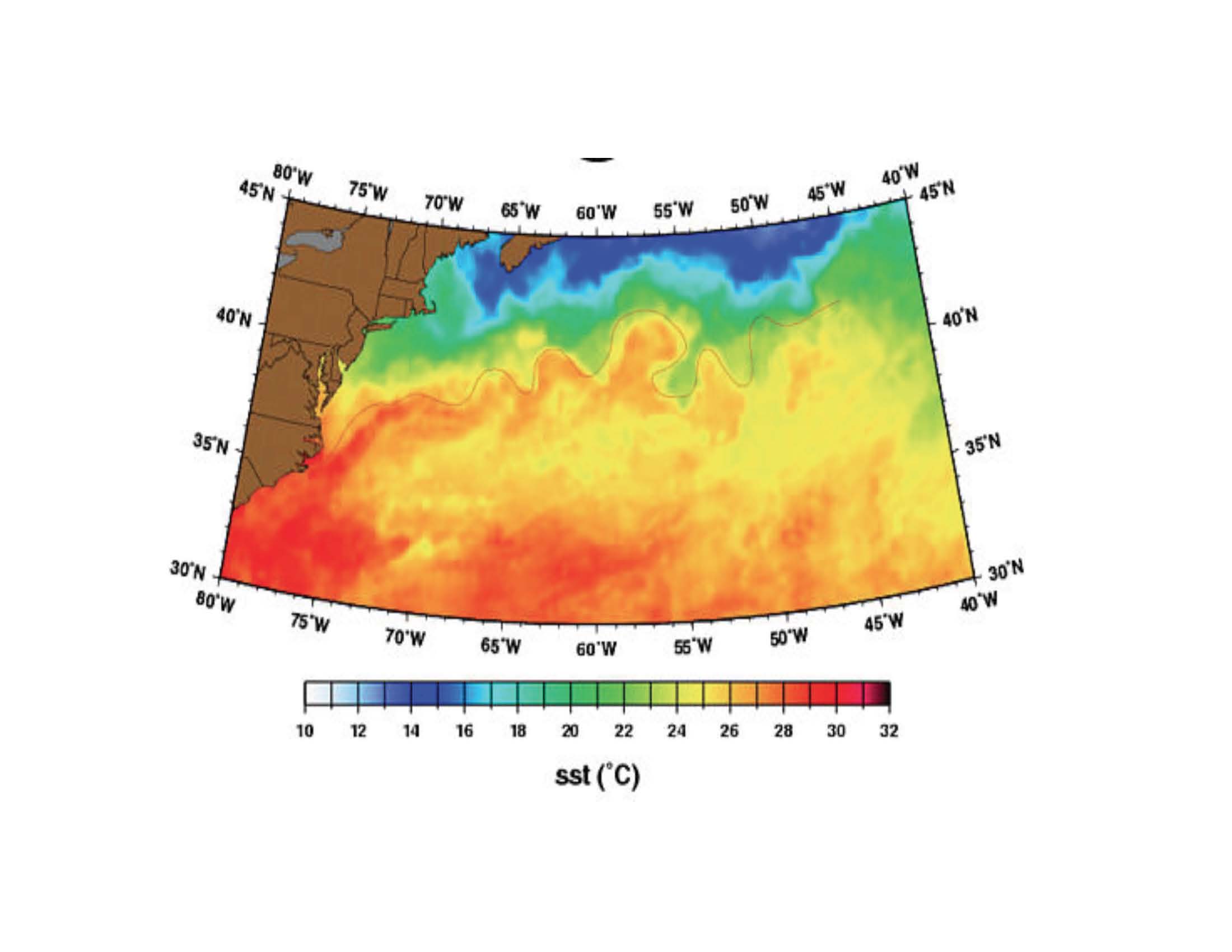
That still might not be fair since the Gulf Stream is a famous warm current just 7 miles offshore FLL, which eventually crosses the entire North Atlantic. That Atlantic snapshot shows an appreciable part of the Gulf Stream influenced Atlantic in July… So here is the entire world in NH winter. That ‘cold’ ≈22°C water off FLL (≈75W long, ≈25N lat) is typical for the winter season when South Florida welcomes the northern snowbirds that flock to its beaches.
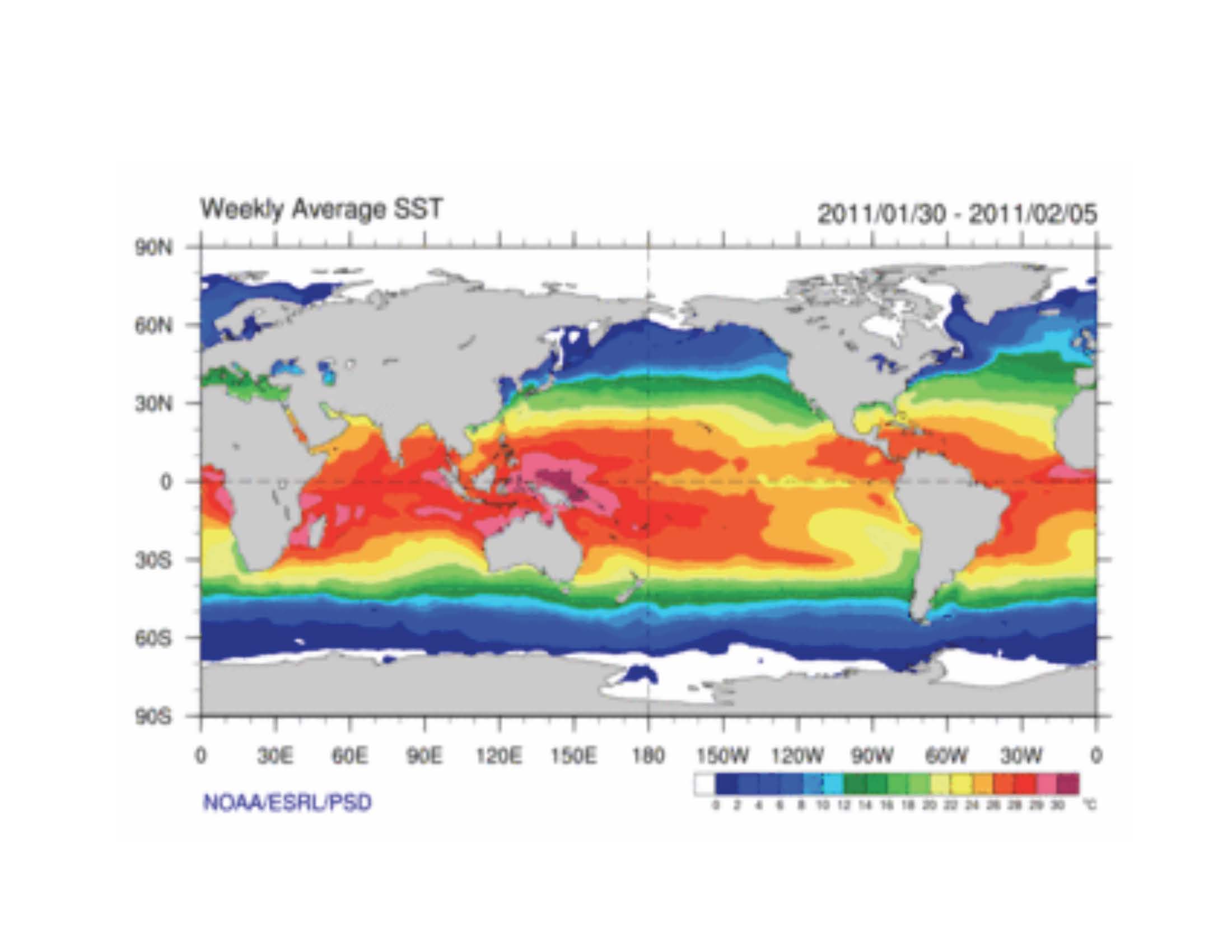
Anybody who thinks a possible +3.5°C anomaly could adversely upset global marine phytoplankton biology cannot be thinking at all. They are ignoring the ocean’s enormous natural seasonal and geographical variation.
They also have not bothered to read the unpaywalled abstract of this new paper, which says (emphasis added):
Marine phytoplankton are responsible for ~50% of the CO that is fixed annually worldwide, and contribute massively to other biogeochemical cycles in the oceans. Their contribution depends significantly on the interplay between dynamic environmental conditions and the metabolic responses that underpin resource allocation and hence biogeochemical cycling in the oceans. However, these complex environment–biome interactions have not been studied on a larger scale. Here we use a set of integrative approaches that combine metatranscriptomes, biochemical data, cellular physiology and emergent phytoplankton growth strategies in a global ecosystems model, to show that temperature significantly affects eukaryotic phytoplankton metabolism with consequences for biogeochemical cycling under global warming. In particular, the rate of protein synthesis strongly increases under high temperatures even though the numbers of ribosomes and their associated rRNAs decreases. Thus, at higher temperatures, eukaryotic phytoplankton seem to require a lower density of ribosomes to produce the required amounts of cellular protein. The reduction of phosphate-rich ribosomes in warmer oceans will tend to produce higher organismal nitrogen (N) to phosphate (P) ratios, in turn increasing demand for N with consequences for the marine carbon cycle due to shifts towards N-limitation.
This is good news for two reasons. First, warmer temperatures increase phytoplankton bioactivity (protein synthesis) all over the globe. Mark 1 Eyeball observations of FLL seasonal reef visibility are true everywhere. It is in the phytoplankton genes. That means more oxygen, more marine food chain food, and more carbon sequestration if waters warm. Second, temperature up-regulated gene expression shifts phytoplankton metabolic pathways away from phosphorus and toward nitrogen. This is a marvelous example of evolutionary adaptation. Phosphorus is a growth-limiting factor in most ocean regions, provided primarily by upwelling deep water. A shift toward ‘N-limitation’ with more bioactivity avoids the phosphorus growth constraint. Oceans have their own nitrogen fixation mechanisms (e.g. cyanobacteria like Trichodesmium) that would also get more productive. Less phosphorus consumed by phytoplankton means more is available to N-fixing cyanobacteria. [3], [4]
Iron is the usual rate limiting phytoplankton and cyanobacteria micronutrient in all oceans at all latitudes.[5], [6] Iron is provided by upwelling deep water or by atmospheric dust. Oceans are mainly fertilized by desert dust. Speculative ocean geo-engineering involves iron (not N or P) fertilization. Little gets biochemically ‘upset’ by Δ temperature. Except in the UEA PR.
According to this paper, Fort Lauderdale’s reef phytoplankton would thrive right there over a longer warmer summer season, sequestering more CO2 and producing more food for the reef’s corals, fish, spiny lobster ‘bugs’, and other beautiful creatures. We might have to sink some more iron ships near the reef to help it out and provide more dive destinations. But I think I’ll hang here rather than panic and move away. Not worried about ice sheet collapse. Not worried about the reef. Not worried about CAGW increasing hurricanes. Worried about MSM and IPCC credibility, and that can be done from anywhere.
This upsetting PR is actually doubly good news. And not just for FLL.
[1] Toseland et. al., The impact of temperature on marine phytoplankton resource allocation and metabolism, Nature Climate Change (2013). Paywalled.
[2] Rose et. al., Synergistic effects of iron and temperature on Antarctic phytoplankton, Biogeosciences 6: 3131-3147 (2009)
[3] Sanudo-Wilhelmy et. al., Phosphorus limitation of nitrogen fixation by Trichodesmium in the central Atlantic Ocean, Nature 411: 66-69 (2001).
[4] Straub et. al., Changes in North Atlantic nitrogen fixation controlled by ocean circulation, Nature 501: 200-203 (2013)
[5] Behrenfeld et.al., Confirmation of iron limitation of phytoplankton photosynthesis…, Nature 383: 508-511 (1996)
[6] On a vast planet, there are always exceptions. The Mississippi provides abundant iron (silt) to the Gulf of Mexico waters around its mouth. N and P would become rate limiting, except that agricultural runoff into the river provides overdoses of both. This causes massive coastal blooms, which in turn deplete seafloor oxygen when the phytoplankton die, sink, and decompose (using up seafloor dissolved oxygen). This creates an annual summer hypoxic/anoxic bottom water zone as the water warms and phytoplankton bloom. This is a terrible seasonal problem for shrimp, crab, and other coastal bottom dwellers. The NOAA 2013 image shows this year’s extent.
JC comments: Rud Istvan submitted this post to me via email. Rud has contributed numerous posts to Climate Etc. Since this is a guest post, please keep your comments relevant and civil.