

When the International Meteorological Organization defined the first climate normal from 1900 to 1930, the belief was that the climate was constant, and that the newly defined climate ‘normal’ would give a close approximation to the climate.
Today, we still use the 30 year ‘normal’ period – referring now to 1960-1990 – but we acknowledge that it is not immutable, that even without anthropogenic effects, that even due to natural causes, the climate changes. But what then is the climate and what is the difference between the climate and the weather? Mark Twain once quipped: “Climate lasts all the time and weather only a few days”. This is close to the popular dictum: “the climate is what you expect, the weather is what you get” [Heinlein, 1973]. Since most people ‘expect’ averages, this concurs with the reigning idea that the climate is a kind of ‘average’ weather. Similarly, the use of Global Climate Models (GCM’s) to predict the climate is based on the idea that for given boundary conditions (solar output, atmospheric composition, volcanic eruptions, land use), that “the climate is what you expect”.
While all this sounds reasonable, it turns out that it is not based on analysis of real world data. In recent papers “What is climate?” and “The climate is not what you expect” ([Lovejoy, 2013], [Lovejoy and Schertzer, 2013]) we used a new kind of ‘fluctuation analysis’ to show that – at least up to 100,000 years – that that there are not two, but rather three atmospheric regimes each with different types of variability. In between the weather (periods less than 10 days) and the climate (periods longer than ≈ 30 years), there is a new intermediate ‘macroweather’ regime.
What does it mean to define a regime by its type of variability? An illustration makes it intuitive. Consider Fig. 1 whichs shows examples from weather scales (1 hour resolution, bottom), macroweather (20 days, middle) and climate (1 century, top).
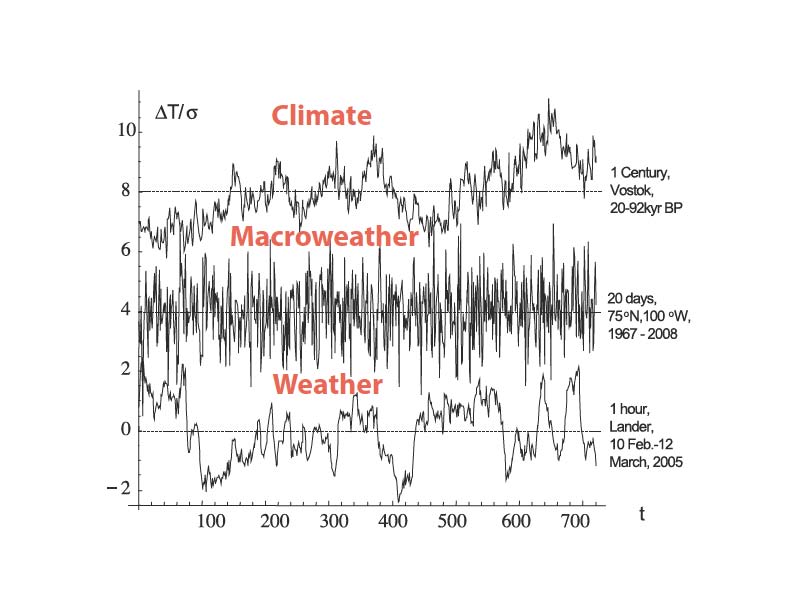
The daily and annual cycles were removed and 720 consecutive points from each resolution are shown so that the differences in the characters of each regime are visually obvious. At the bottom, the weather curve ‘wanders’ up or down resembling a drunkard’s walk, typically increasing over longer and longer times periods. In the middle, the macroweather curve has a totally different character: upward fluctuations are typically followed by nearly cancelling downward ones (and visa versa). Averages over longer and longer times tend to converge, apparently vindicating “the climate is what you expect” idea: we anticipate that at decadal or at least centennial scales that averages will be virtually constant with only slow, small amplitude variations. However (top) the century scale climate curve displays again a weather-like (wandering) variability. Although this plot shows temperatures, other atmospheric fields (wind, humidity, precipitation, etc.) are similar.
There are thus three qualitatively different regimes, a fact was first recognized in the 1980’s and that has been confirmed several time since, but whose significance has not been appreciated [Lovejoy and Schertzer, 1986], [Pelletier, 1998], [Huybers and Curry, 2006]. The old analyses were based on analyzing temperature differences and spectra, and these suffered from various technical limitations and from difficulties in interpretation. The new technique works by defining fluctuations over a give time interval by the difference of averages over the first and the second halves of the interval; it is thus very easy to interpret. In the ‘wandering’ weather and climate regimes, the averaging in the definition isn’t important, fluctuations are essentially differences. In the cancelling ‘macroweather’ regime, the differences aren’t important, the fluctuations are essentially averages.
Whereas in the weather and climate regimes, fluctuations tend to increase with time scale, in the macroweather regime, they tend to decrease. For example, over GCM grid scales (a few degrees across), the average fluctuations increase on average up to about 5oC (≈9o F) until about 10 days. Up until about 30 years they tend to decrease to about 0.8o C (≈ 1.4o F), and then – in accord with the amplitude and time scale of the ice ages – they increase again up to about 5o C (9o F) at ≈100,000 years. In macroweather, averages converge: “macroweather is what you expect”. In contrast, the ‘wandering’ climate regime is very much like the weather so that – at least at scales of 30 years or more – the climate is “what you get”. Conveniently, we see that the choice of 30 year time period to define the climate normal can now be justified as the time period over which fluctuations are the smallest.
In a nutshell, average weather turns out to be macroweather – not climate – and climate refers to the slow evolution of macroweather. This evolution is the result of external forcings (solar, volcanic etc.) coupled with natural (internal) variability: i.e. forcings with feedbacks. In the recent period, we may add anthropogenic forcings.
Why ‘macroweather’, and not ‘microclimate’? It turns out that when GCM’s – which are essentially weather models with extra couplings (to oceans, sea ice etc.) are run in their ‘control’ modes (i.e. with constant atmospheric composition, solar output, no volcanoes etc.) – that fluctuation and other analyses show that they well reproduce both the weather and the macroweather types of wandering and canceling behaviours, so that macroweather is indeed long term weather. To obtain the climate they must at least include new climate forcings, but probably also new internal climate mechanisms; a recent fluctuation study shows that the multicentennial variability of GCM simulations over the period 1500-1900 are somewhat too weak [Lovejoy et al., 2012a].
But what about the current period with strongly increasing levels of greenhouse gases? Although we’ve only started looking at this, initial results comparing fluctuation analyses of surface temperature measurements and historical GCM runs (1850-present) show that there is a good level of agreement in their multidecadal and centennial scale variabilities [Lovejoy et al., 2012b]. However, the reason for the agreement appears to be that over this period, most of the long term variability of both the data and the models are due to the anthropogenic forcings that are sufficiently strong that they dominate the natural variability. It is worth recalling that fluctuation analysis only indicates the types and overall levels of variability at different time scales, it does not directly validate any specific model predictions. However, if further research confirms our conclusions, it would mean that anthropogenic induced warming is the most important factor in explaining the variability since 1850.
References
Heinlein, R. A. (1973), Time Enough for Love, 605 pp., G. P. Putnam’s Sons, New York.
Huybers, P., and W. Curry (2006), Links between annual, Milankovitch and continuum temperature variability, Nature, 441, 329-332 doi: 10.1038/nature04745.
Lovejoy, S. (2013), What is climate?, EOS, 94, (1), 1 January, p1-2.
Lovejoy, S., and D. Schertzer (1986), Scale invariance in climatological temperatures and the spectral plateau, Annales Geophysicae, 4B, 401-410.
Lovejoy, S., and D. Schertzer (2013), The climate is not what you expect, Bull. Amer. Meteor. Soc., (in press).
Lovejoy, S., D. Schertzer, and D. Varon (2012a), Do GCM’s predict the climate…. or macroweather?, Earth Syst. Dynam. Discuss., 3, , 1259-1286 doi: 10.5194/esdd-3-1259-2012.
Lovejoy, S., D. Schertzer, and D. Varon (2012b), Response to R. Betts: Interactive comment on “Do GCM’s predict the climate… or macroweather?” Earth Syst. Dynam. Discuss., 3, C778–C783.
Pelletier, J., D. (1998), The power spectral density of atmospheric temperature from scales of 10**-2 to 10**6 yr, , EPSL, 158, 157-164.
JC comment: This post originated from a conversation with Shaun Lovejoy at the AGU meeting, where I invited him to do a guest post based on his recent two papers. Since this is a guest post, comments will be moderated STRICTLY for relevance and civility.