

by X Anonymous
According to the IPCC, “climate variability refers to variations in the mean state and other statistics (such as standard deviations, the occurrence of extremes, etc.) of the climate on all spatial and temporal scales beyond that of individual weather events. Variability may be due to natural internal processes within the climate system (internal variability), or to variations in natural or anthropogenic external forcing (external variability).”
Known examples of internally generated variability include ENSO, AMO, and the PDO. An example of Internal variability which exists on a longer time scale is Thermohaline Circulation. There are many other examples of internal variability, especially when we include instances where the line between internal and external phenomena is blurred, and when the Earth’s climate system state has changed (e.g. Heinrich events during the last glacial period).
Is there a difference between ‘climate change’ and ‘climate variability’? Time is the key. Even though the interglacial cycles or “Ice Ages” are some of greatest ‘climate changes’ known, and are described as the change between two ‘long term’ climate states, they are cyclical. What sets these glacial cycles apart from other examples of ‘variability’ is the hundreds of thousands of years of evolution through time, and apparent external forcing. Therefore, when we hear about ‘internal variability’ in the context of attribution, ENSO, the AMO, and other short term ‘noise’ are often referred to, since the longer time scale variability is unlikely to have much impact (as impossible as that is to prove).

Therefore, it is fair and reasonable to assume these short term influences on the climate are short term. It’s a zero sum game when it comes to the IPCC’s use of internal variability. As the figure above illustrates, internal variability is the slave and external forcing is the master. All internal variability can do is move energy around. There is no significant net change in energy consistent with the laws of thermodynamics, where energy cannot be created nor destroyed. The climate must be forced to change in the long term; internal variability is unforced and does not cause long term temperature trends.
Historical data and observations are used to estimate internal variability. Since the observable patterns of variability cannot explain long term temperature trends, external forcing is needed to provide a physical explanation. And since the external forcing generally doesn’t have much impact on its own, a positive (water vapor) feedback, consistent with atmospheric physics, is evoked to explain the discrepancy.
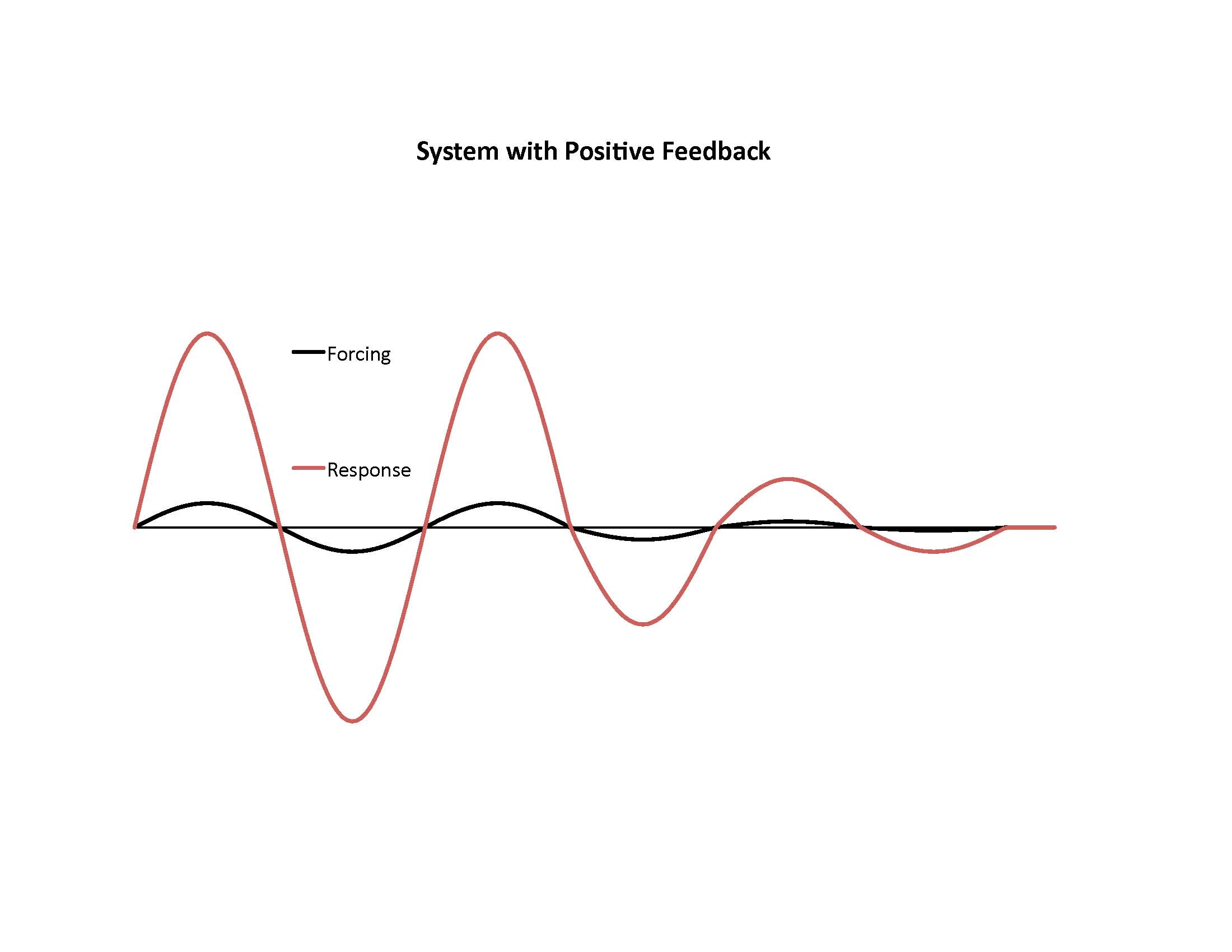
The above shows a climate system with a high sensitivity. On Earth, the ocean is responsible for a very large system memory; the only consequence of this enormous potential of energy in a system dominated by positive feedback, however, is to cause a system lag, which constrains the time it takes for the climate to change.
To summarise, the IPCC have largely ruled out internal climate change, and used physics to exaggerate processes that would normally have little impact on their own, to explain the origin of the climate. In the IPCC’s view, the ocean can store an enormous amount of energy, but at no time can that potential energy influence long term climate change under a dominate positive feedback. Ultimately, with or without a system lag, it all comes down to external forcing. Periods of hiatus /rapid warming, etc. cancel out in the long term. There is no doubt the attribution of 20th century warming has been simple and straight forward due to human emissions.
In contrast to a system depended on positive feedback, the impact of external forcing is reduced with a system based on a negative feedback, and the initial ‘cause’ or ‘origin’ of climate change is far more ambiguous. Unless a specific negative feedback mechanism is known, attribution is near impossible. Attribution is synonymous with positive feedback. As noted by climate researchers, attribution of warming to an internal process such as the ENSO cycle requires a highly sensitive climate with positive feedback to work!
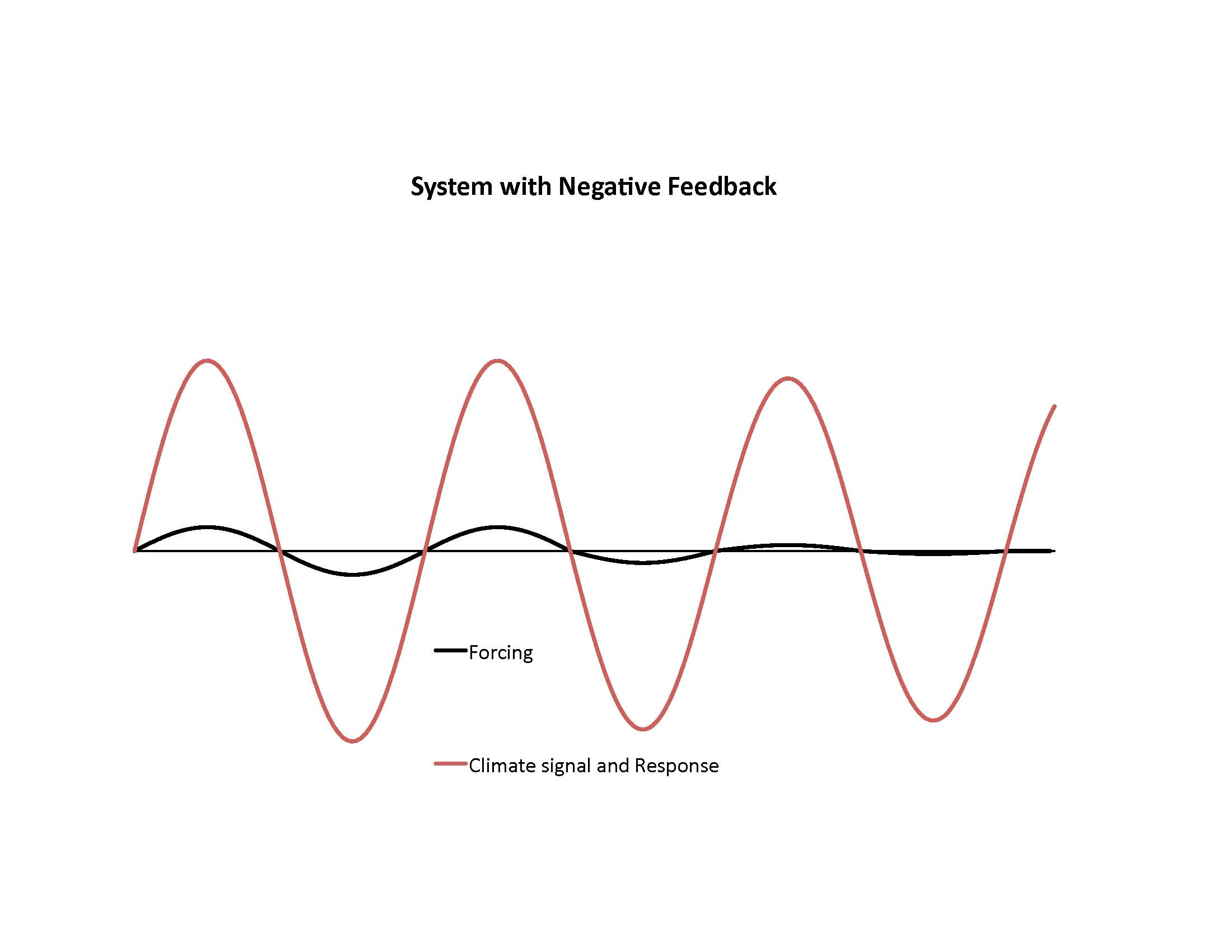
In this ‘negative feedback’ world, climate sensitivity is low. The system is hard to change with external forcing. In contrast to the previous ‘positive feedback’ example, the associated external forcing does not immediately explain the magnitude of the climate signal. By its own nature, a negative feedback system requires climate changes to be attributed (for the most part) to internal variability. External forcing therefore plays only a minor role, leaving the feedback as the dominate driver of change (‘the cause’). Attribution then requires knowledge of internal dynamics (are they random or deterministic?). A significant, dominate role for internal variability would be impossible without a system memory. A positive feedback does not require a system memory, yet we live in a world which has one.
The climate signal in the figure above may have been caused by the forcing, but only very slowly over time. It may have taken a million years. Since external forcing can only cause a small deviation from equilibrium (due to low climate sensitivity), such a forcing would need to be periodic in nature (such as orbital forcing), in order to change the system in the long term. In the absence of external forcing, the climate oscillation that has accumulated over a million year time period, will take another million years to stop oscillating completely and return to equilibrium. A million years of climate change with no external forcing is theoretically possible under a system with both a memory and negative feedback. Impossible under a positive system.
Attribution studies which claim that 20th century warming has no alternative explanation other than manmade greenhouse forcing are only credible in a hypothetical positive feedback world. In other words, there is no alternative explanation in these studies because they have only considered positive feedback mechanisms. Ruling out Internal variability as a driver of change inevitability means negative feedbacks are also ruled out, and vice versa.
Evidence of a negative feedback is found in climate records which exhibit characteristic of system memory, such as an accumulation of periodic energy:

This figure shows the climate record of Lisiecki and Raymo (2005) constructed by combining measurements from 57 globally distributed deep sea sediment cores. The measured quantity is oxygen isotope fractionation (δ18O) in benthic foraminifera, which serves as a proxy for the total global mass of glacial ice sheets. Source: Wikipedia
Until climate scientists consider internal variability in the context of both positive and negative feedback systems, it is unlikely the great mysteries of climate change will be solved.
JC comment: This essay landed in my inbox this morning, I have not communicated previously with the anonymous author. This essay speaks to a concern that I have had regarding the separability of natural internal variability from forced variability, particularly as we detrend a time series to identify the natural internal variability. I have suspected that all this may be convoluted and not easily separable, with external forcing projecting onto the modes of internal variability. And particularly since we are looking at a period of about 3 decades as being the main ‘signal’ from CO2 forcing, we don’t really know how to do the attribution problem on this time scale.
Moderation note: This is a technical thread, pls keep your comments relevant (and civil).