

by Judith Curry
Tropical Storm Isaac is now spinning up in the Gulf of Mexico. The models have finally converged on New Orleans as the landfall location. Are better forecasts of hurricanes possible? New research is pointing the way for improvements, and more useful hurricane forecasts are becoming available from the private sector, particularly at longer time horizons and also with regards to landfall impacts.
State of the hurricane forecasting art
The U.S. National Hurricane Center provides 5-day forecasts of individual hurricanes. Track forecasts are issued only after the storm has been named. Probabilities for formation are provided up to two days in advance. A recent overview of the NHC’s hurricane forecast methodology and their plans for the future are described in this article recently published by the Bulletin of the American Meteorological Society (BAMS) entitled ‘NOAA’s future ensemble based hurricane forecasts’ [Abstract] [Text] [Supplemental information].
In addition to the National Hurricane Center, private sector companies are also providing hurricane forecasts. The Weather Channel/WSI provides longer range hurricane forecasts, and typically discuss possible tracks before the storm forms, which includes the ensemble based tropical cyclone forecast products provided by ECMWF. My company, Climate Forecast Applications Network (CFAN) also provides extended range forecasts and outlooks out to 32 days. And I’ll also give Ryan Maue a plug, who has joined WeatherBell, and is also making hurricane forecasts for the private sector.
Need for improved hurricane forecasts at longer range
Most of the focus for improving NHC forecasts has been on improving the intensity forecast, which has shown relatively little improvement over the past decade and remains a substantial challenge. Track forecasts out to 5 days have shown continual improvement in recent decades.
Whereas 2-3 day forecasts are arguably sufficient for public safety and evacuation planning, extended range forecasts and better uncertainty information could be used to support decision making:
- Shipping and ocean routing, especially for very slow moving carriers for oil rig construction
- Offshore resource operation and safety
- Energy trading (supply and demand impacts)
- Travel and tourism impacts
- Stocking of home improvement stores
- Allocation of national emergency management resources
- Disaster planning and mitigation in the developing world, where additional lead time is desirable for evacuation, etc.
- Management of public health resources
Several companies in the private sector are making hurricane forecasts out to 10 days and beyond.
New ensemble-based forecasting method
The BAMS article referenced above recommends the following specific improvements:
- Ensemble based intensity forecasts
- Tropical cyclogenesis products
- Storm size products
- Track products with clustering and dynamic cones of uncertainty
- Probabilistic guidance for storm impacts: surge, wind, rain, tornadoes
Further, better uncertainty characterization is needed, particularly as forecast time horizon is extended beyond 5 days.
Research at Georgia Tech is addressing these issues, some of which is published in the following papers:
- Belanger, JI, PJ Webster, JA Curry, MT Jelinek, 2012: Extended Prediction of North Indian Ocean Tropical Cyclones. Weather and Forecasting, [pdf]
- Agudelo, PA, CD Hoyos, JA Curry, PJ Webster, 2011: Probabilistic discrimination between large-scale environments of intensifying and decaying African Easterly Waves. Climate Dynamics, 36, 1379-1401 [pdf]
- Belanger, JI, JA Curry, PJ Webster, 2010: Predictability of North Atlantic Tropical Cyclone Activity on Intraseasonal Timescales. Mon. Wea. Rev., 138, 4362-4374. [pdf]
- Belanger, JI, JA Curry, CD Hoyos, 2009: Variability in tornado frequency associated with U.S. landfalling tropical cyclones. Geophys. Res. Lett., 36, L17805. [pdf]
This research has been translated into the design of a new operational ensemble based hurricane forecast system, based largely upon the Ph.D. research of James Belanger. James successfully defended his Ph.D. this summer, and also recently received the 2012 Natural hazards Focus Group Award for Graduate Research from the American Geophysical Union.
This forecast system is used operationally by my company, Climate Forecast Applications Network (CFAN), which has been making extended range hurricane forecasts since 2007, in both the North Atlantic and North Indian Ocean. Until this year, our Atlantic forecasts were provided on an exclusive basis to a single client in the energy sector to support energy sales, marketing, and trading (particularly natural gas). This year, our forecasts are being marketed more broadly, and I can talk about them publicly to some extent.
Information on CFAN’s hurricane forecast products can be found [here]; see also this brochure. A brief synopsis from this material is provided below:
CFAN’s tropical cyclone forecast products are based on a sophisticated analysis of the ECMWF Variable Ensemble Prediction System 1-15 day and monthly forecast products (16-32 days) that is integrated into a multi-model analysis with forecasts from other global and regional models. CFAN’s probabilistic forecasts of Atlantic tropical cyclone tracks show skill within 300 miles out to 7 days (even before the tropical cyclones actually form). CFAN’s unique tropical cyclogenesis model has demonstrated skill 3-10 days in advance for predicting the formation of tropical cyclone associated with African Easterly Waves, and skill 7-10 days in the North Indian Ocean.
Landfalling impacts
The other area where the private sector has been making progress is on landfall impacts. A few companies are providing detailed wind forecasts upon landfall and the detail of individual zip codes.
In the impacts area, CFAN has focused its efforts on predicting landfall impacts associated with size (horizontal extent) and translation speed, in addition to intensity. All other things being equal for a Gulf landfall, the slower the movement of the storm, the greater the storm surge, rainfall, and wind damage. Large hurricanes are associated with greater storm surge, more local rainfall, and a greater number of tornadoes.
Tropical Cyclone Isaac: Forecast history
So how does all this stack up in context of the Isaac forecasts? A side-by-side comparison of NHC vs CFAN can be found here Isaac_CT. Here is a quick summary of the forecasts from the National Hurricane Center and CFAN:
National Hurricane Center forecast history
- Aug 17: first mention of the system, 10% chance of formation by 8/19
- Aug 18: 40% chance of formation by 8/20
- Aug 20: 80% chance of formation by 8/22; named NHC 94L
- Aug 21: 75% chance of HR, 7% chance MHR, Caribbean in cone; named TD9
- Aug 22: 59% chance of HR, 7% chance of MHR; cone encompasses Car, GOM, SE Atl coast; named TS Isaac
- Aug 23: 32% chance of HR, both GoM and East FL coast in cone
- Aug 24: 29% chance of hurricane, 3% chance of MHR; landfall Pensacola to Mobile; both GoM and East FL coast in cone
- Aug 25: 57% chance of hurricane, MHR 7%; landfall Panama City; both GoM and East FL coast in cone
- Aug 26: 67% chance of hurricane, 8% chance of MHR; landfall Mobile AL
- Aug 27: 62% chance of hurricane; 6% chance of MHR; landfall New Orleans
CFAN’s forecast synopsis history for Isaac is provided below:
Aug 13: Wave J – The next robust wave to depart Africa will enter the Atlantic basin around August 18th. Model support for development has been fairly steady for several days and the system is being named Wave J as the risk of tropical cyclone formation is now moderate (30-60%). Although the long term track of the system remains uncertain, risk levels have increased to low (10-30%) for the CAR during the 11-15 day period.
Aug 16: CFAN J – The strong wave that we’ve been discussing all week will finally depart Africa on Friday, slightly ahead of schedule. Model support continues to increase for this wave leading us to increase the risk of tropical cyclone formation to high (60%+) and therefore name the system CFAN J. Formation is still expected to happen in the central Main Development Region (MDR), and is likely to occur between 8/21 and 8/23. The expected trajectory still favors movement into the open Atlantic after 8/24, but there is enough uncertainty to keep risk levels for the Caribbean in the low (10-30%) range. CFAN J is showing signs of being a classic Cape Verde storm and is already posing moderate (30-60%) risk of becoming a hurricane.
Aug 18: CFAN J (NHC 94L) – Currently centered near 13N x 28W in the southeastern MDR, CFAN J continues to become better organized. Risk of TC formation remains high (60%+) and is most likely to occur sometime Monday in the central MDR. Most global models and ensembles have shifted the long-term trajectory of CFAN J significantly westward since yesterday’s update due to delayed intensification. Our forecast trajectory today has shifted westward but is in best agreement with a blend of the NCEP and ECMWF ensemble mean. Risk of movement into the Caribbean (CAR) is now moderate (30-60%) with entry into the CAR, across the Leeward Islands expected around 8/23. Thereafter, a turn towards the northwest should result in movement along or just north of the Greater Antilles. Due to the westward shift in track, risk levels for the Coastal Southeast U.S. (CSE) have increased today to low (10-30%), as has the risk of entry into the GoM (10-30%), mainly for the period after 8/27. CFAN J continues to pose a moderate (30-60%) threat of becoming a hurricane.
Aug 20: Currently centered near 15N x 45W in the central Main Development Region (MDR), the organization of CFAN J did not change significantly over the weekend. Although the system is battling drier air to the north there is still a high risk of tropical cyclone formation before it reaches the Lesser Antilles on Wednesday. Due to the slower rate of development, global models are continuing to bring CFAN J farther west. Risk to the GoM is increasing but remains low (10-30%) primarily because of a trajectory along the Greater Antilles which may lead to dissipation. Entry into the Gulf of Mexico could occur as early as 8/27. Risk levels for the Coastal Southeast remain low (10-30%), and risk levels in the Production Region are also now low (10-30%) beginning 8/29. CFAN J continues to pose a moderate (30-60%) threat of becoming a hurricane.
Aug 21: Tropical Depression 9 (TD9) – CFAN J became the 9th tropical depression of 2012 and is currently located near 15N x 52W, with maximum winds of 35mph. Our forecast, which is generally in line with the National Hurricane Center through 8/26, calls for a west track through 72 hours and then a turn toward the WNW keeping TD9 south of Greater Antilles’ land masses. Then movement over Cuba is expected, although the precise location and timing are likely to be influenced by a trough moving over the eastern U.S. over the weekend. However, a position near the southeastern edge of the Gulf of Mexico / Florida is expected on 8/28. The long-term track today favors movement into the Gulf but only slightly more than a track up Florida or its east coast. Both the Gulf and Coastal Southeast regions now have moderate (30-60%) risk for tropical cyclone activity, but the Production Region risk level remains low (10-30%). Despite expected land interaction, TD9 still has a high (60%+) chance of reaching hurricane intensity. Should this occur during the next 72 hour window, this could lead to a shift in favor of the more eastern track projection.
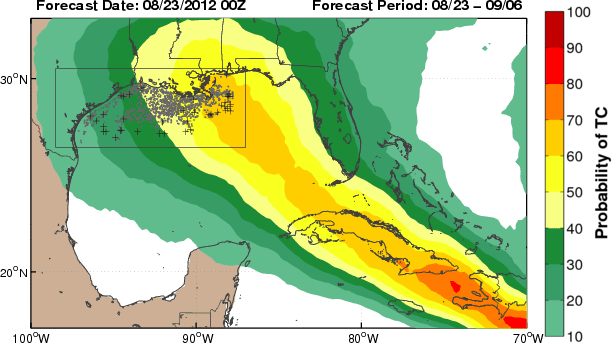
[JC note: 8/22 at 00UTC is the first time our track forecasts decisively went into the GoM. Although the landfall location looks centered on New Orleans, there is still a wide cone of uncertainty, and subsequent predictions vascillated between Pensacola FL and New Orleans].
Aug 23 Tropical Storm Isaac – Currently located in the eastern Caribbean south of Puerto Rico, Isaac has not intensified during the last 24 hrs. Our track forecast for today is best captured by a blend of the latest ECMWF deterministic and NHC operational forecasts. We reiterate that the NHC track forecast remains too far to the east, and their slow adjustment in recent runs to the west is likely to continue in future forecasts. In addition, the latest CFAN forecast for timing of track movement continues to trend toward faster forward motion. Isaac is poised to enter the Gulf of Mexico through the Florida Straits by 8/27 12Z, be located near 27N x 85W by 8/28 12Z, and landfall is forecast to occur around 8/29 12Z near Pensacola, FL. The landfall cone of uncertainty is currently bounded to the west by Marsh Island, LA and to the east by the coastal Big Bend of Florida. Given the current trajectory, risk levels for a track through the Production Region (PR) have increased from previous updates and are now at the upper end of moderate (30-60%) thresholds. In terms of the timing of tropical storm force winds in the PR, they are most likely to begin by the morning of 8/28 and end by the morning of 8/30. We expect that Isaac will enter the GoM as a weak to moderate tropical storm and will have about 2 days to undergo additional development. Environmental conditions now suggest that Isaac has less chance of undergoing rapid intensification during this time. Accordingly, we expect a weak intensification rate during this two day period which would likely lead Isaac to be a strong tropical storm to borderline category two hurricane at the time of final landfall. At this time risk of reaching major hurricane status is now minimal (<10%).
Aug 23 pm: Tropical Storm Isaac – As of 7PM EDT, Isaac was centered near 15.6N x 67.2W and was producing maximum sustained winds near 40 mph. Through the next 72 hrs, the forecast track is in good agreement with the latest global model consensus including the 12Z ECMWF deterministic forecast and the 5PM NHC update. We expect that by tomorrow morning Isaac will begin turning to the west-northwest, followed by a turn to the northwest, placing the system over Cuba (near 23.5N x 80.5W) by the early afternoon on Sunday (8/26). Beyond this time frame, forecast uncertainty has increased since this morning’s update. The latest set of American model guidance including the 5PM NHC update has shifted westward from previous forecasts but remains tightly clustered through the eastern Gulf of Mexico (GoM). By the early afternoon of Tuesday (8/28), the NHC suggests Isaac will be centered about 100 miles due south of Panama City. In comparison, the latest set of ECMWF ensemble guidance has shifted more significantly westward by about 200 miles, with the bias-corrected ECMWF deterministic now forecasting Isaac to make landfall near the Texas/Louisiana border by Thursday afternoon (8/30) as a moderate category 1 hurricane. Given the westward shift in model track guidance this afternoon, our track forecast has similarly shifted westward (by about 100 miles) with landfall now projected to occur near Gulfport, MS, with the cone of uncertainty now bound to the west by Galveston Island, TX and to the east by Tallahassee, FL. Although forecast uncertainty in the final landfall location is now larger than this morning, confidence in Isaac tracking through the Production Region (PR) has increased and is now high (60%+). Tropical storm force winds are most likely to begin by the early morning of Tuesday (8/28) and end by the afternoon of Thursday (8/30). Finally, due to the increased potential for a more westward track across the northwestern GoM, the maximum intensity forecast has been increased this evening, as as there is now a low (10-30%) threat of Isaac reaching major hurricane status.
Aug 24: Tropical Storm Isaac – As of 8AM EDT, Isaac was centered near 15.9N x 70.4W, approximately due south of Santo Domingo, Dominican Republic. The storm is slowly becoming better organized and maximum sustained winds are up slightly to 50 kts. Isaac has about 12 more hours before skirting Hispaniola and an additional 12 hours before reaching Cuba. That provides a small window for strengthening and the system is only expected to be a moderate to strong tropical storm when it moves across Cuba on Saturday. The CFAN forecast is in best agreement with the GFS and is largely in line with this morning’s operational forecast from the National Hurricane Center. The storm will enter the Gulf of Mexico through the Florida Straits overnight Sunday. Landfall is forecast to occur Tuesday night near Pensacola, FL or Mobile, AL. The landfall cone of uncertainty is bounded to the west by Houma, LA and to the east by Crystal River, Florida. The risk of movement through the Production Region has decreased slightly from yesterday evening’s update but is still high (60%+). It must be stressed that the current poor organization of the system and amount of land Isaac will encounter in the next 48 hours leads to a large amount of uncertainty in the long term track and intensity. In terms of the timing of tropical storm force winds in the Production Region, they are most likely to begin overnight Monday or early Tuesday morning (8/28) and last through midday Wednesday (8/29). With the current track, these winds would likely remain below hurricane intensity and be limited to the eastern portion of the Production Region. We expect that Isaac will enter the GoM as a weak tropical storm and will have about 60 hours to become better organized and undergo additional development. There is still a high (60%+) chance that Isaac will become a hurricane, and the intensity at landfall is expected to be strong tropical storm to category 1 hurricane.
Aug 25: Tropical Storm Isaac – The CFAN forecast for Tropical Storm Isaac has not changed significantly in the past 24 hours. . .
Aug 26: Tropical Storm Isaac – Currently moving through the Florida Straits, Issac is gaining organization and is likely to become a hurricane later today as it enters the Gulf of Mexico. Since Saturday, the CFAN forecast for Isaac has shifted westward in agreement with the latest model consensus, well west of this morning’s forecast from the National Hurricane Center. Landfall is now expected near New Orleans, LA by Tuesday evening or in the early overnight hours, and the cone of uncertainty has narrowed and is now bound to the west by Marsh Island, LA and to the east by Panama City, FL. The risk of movement through the Production Region has increased today and remains high (60%+). We expect Isaac to be a strong category 2 storm at landfall and the risk of it becoming a major hurricane continues to increase but is just within the upper moderate range (30-60%). At this time, risk of reaching category four or five intensity has increased but remains low (10-30%). In addition to tropical storm force winds, the risk of hurricane force winds in the Production Region is also now high (60%). Tropical storm force winds for the Production Region are likely to begin late Monday morning and last until early Wednesday afternoon. Finally, based on the latest size forecasts from the European model guidance, Isaac is forecast to become the sixth largest landfalling Gulf TC since 1920. This large horizontal size coupled with his fast forward motion should lead to substantial wave setup leading up to landfall. Significant wave heights are expected to reach 30-35 ft, individual weight heights may reach 50-60 ft, and swell heights will likely reach 10-15 ft.
Aug 27: Tropical Storm Isaac – As of 8AM EDT, Isaac was centered in the SE Gulf of Mexico near 25.8N x 84.8W. Although the satellite presentation has shown increasing organization for the past 24 hours and the pressure has been slowly falling, strengthening has not occurred as anticipated. Maximum sustained winds are still 55 kts, although wind shear is expected to diminish over the next 12 hours and Isaac is still expected to become a hurricane later today. The forward speed has slowed considerably from yesterday and is now WNW at 14 mph. The CFAN forecast for Isaac remains in line with yesterday’s forecast. The National Hurricane Center has also shifted slowly westward over the past 24 hours and is now in agreement with our forecast from Sunday. Landfall is still expected in SE Louisiana (near New Orleans) Tuesday evening or in the early overnight hours and the cone of uncertainty is now bounded to the west by Cameron, LA and to the east by Mobile, AL. We expect Isaac to be a strong category 1 or weak category 2 storm at landfall and the risk of it becoming a major hurricane has decreased but remains within moderate (30-60%) thresholds. Tropical storm force winds are expected to begin in the SE portion of the Production Region by early this afternoon and last through Wednesday evening, mainly in the NE portion of the Production Region. Hurricane force winds are most likely between early Tuesday morning and the pre-dawn hours of Wednesday morning. Isaac is not expected to be as anomalously large as yesterday’s forecast, but is now likely to have the horizontal extent of Hurricane Betsy 1965 or Hurricane Ivan 2004. Due to the decrease size and intensity, significant wave heights are now expected to reach 20-25 ft, individual weight heights may reach 45-50 ft, and swell heights will likely reach 15 ft. In addition to the wind, surge, and flood risk, Isaac is also expected to be a prolific tornado producer. The latest CFAN forecast projects 45-60 tornadoes across the SE U.S. and into the Ohio River Valley, now through September 2nd.
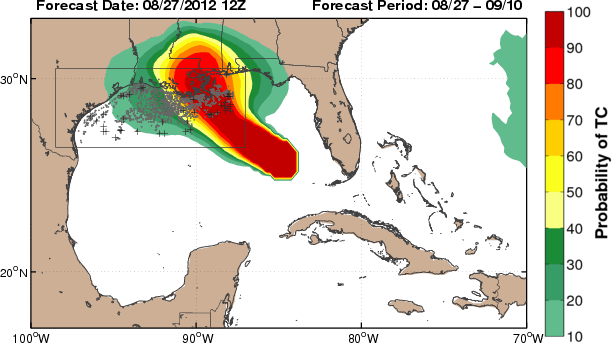
[JC note: here is predicted landfall location and cone of uncertainty as of 12 UTC Aug 27. At this point, the models have all converged on a landfall location near New Orleans.]
Aug 28:
———–
We did a good job of predicting the formation of this system. It remains to be seen how well our track and intensity forecasts turn out.
Verification statistics
In terms of verification statistics for last year, see this recent presentation EN Energy Summit CFAN.
Isaac was a classical Cape Verde storm, and was a case with relatively high predictability, even before it became a tropical storm. Not all tropical cyclones are this predictable. This season, predicting the landfall location of Debbie was particularly vexing, as the models disagreed on whether the track would turn east or west as landfall approached. Last year, the track of Hurricane Irene was highly predictable, although the intensity forecasts are problematic.
Some storms and conditions have higher predictability than others. Ensemble based approaches being used by CFAN and WSI are providing extended lead time on hurricane forecasts. With appropriate ensemble interpretation (including correcting for bias and distributional errors) , we are making intensity forecasts with essentially the same skill as the multi-model deterministic intensity forecasts made by the NHC. The key challenge in making extended range forecasts is to be able to assess how much confidence to place in a particular forecast. Understanding the predictability of tropical cyclone formation and intensification remains at the forefront of making extended range forecasts. And finally, the final forecast has an element of subjectivity in it, and is dependent to some extent on who the individual lead forecaster is for that date.
CFAN’s forecasts of Gulf landfall impacts are experimental, it will be interesting to see what magnitude of storm surge materializes, and how many tornadoes are spawned. It ain’t over til its over. Stay tuned.
Disclaimer: These forecasts are provided only to illustrate the forecast methods. Decisions made to evacuate or whatever should follow closely the warnings and recommendations made by the National Hurricane Center.