

by DocMartyn
This is the first of a three part presentation where I will attempt to explain the climate of the last 800,000 thousand years, drawing on the role of the biosphere’s response to interstellar dust.
Introduction
It has been proposed that atmospheric CO2, and to a lesser extent CH4, are the main drivers of the steady state atmospheric temperature, within the +2 and -10 °C relative temperature variability band that has been observed via the ice core record of the last 800,000 years. The equilibrium climate sensitivity is typically described as the increase in global temperature that results from a doubling of the concentration of CO2 from its pre-industrial value of 280 ppm to 560 ppm, sometimes presented using the notation ΔTx2. The IPCC Third Assessment Report (TAR) said ΔTx2 was “likely to be in the range of 1.5 to 4.5 °C” [1]. In the IPCC Fourth Assessment Report (AR4) climate sensitivity was estimated to be in the range 2 to 4.5 °C with a best estimate of about 3 °C, and is very unlikely to be less than 1.5 °C, but values higher than 4.5 °C cannot be excluded [2]. More recently, a value near or around 3 °C has been put forward [3].
Many people have questioned such high values, including Roy Spencer, who examined the satellite temperature record and arrived at a very low value for ΔTx2 [4]. In response to Spencer’s work Gavin Schmidt, a NASA Goddard climatologist stated [5] “Climate sensitivity is not constrained by the last two decades of imperfect satellite data, but rather the paleoclimate record.”
Herein we examine possible causes of the temperature changes in the recent 800,000 year history of the Earth, as recorded in the Dome C Antarctica Ice Cores. We make no a priori assumption that the levels, or changes in the levels, of CO2 and other ‘greenhouse gasses’ are responsible for the changes in temperature over the various ice-age cycles. Instead, we examine the historical record and from first principles postulate a completely different physical mechanism for temperature variation.
Data
The EPICA Dome C Ice Core Timescales EDC3 (Parrenin, Loulergueand E. Wolff, 2007) provides the basis for this analysis [6]. The dust data (laser dust mass concentration) is from Lambert et al., 2009 [7]. Dust is presented as μg/g and as Log10(ng/g). The EPICA Dome C Ice Core 800KYr Deuterium Data and Temperature Estimates reconstruction series used is that of Jouzel et al [8]. Note, the updated and corrected version is used throughout. All data are available at this link.
In the original datasets there are 7,538 data points in the dust series and 5,800 data points in the deuterium series. Points in the two series are paired so that they were EDC3 dated less than 50 years apart. This gives rise to a paired dataset with 3,894 points. At no stage were these points averaged, in-filled, smoothed or manipulated in any manner that is not explicitly stated.
Results
It is well known that temperatures reconstructed from ice cores show a (lagged) correlation with CO2. However, there is a much better correlation between atmospheric temperatures, as determined by the 1H/2H ratio, and the presence of insoluble particulates.
Figure 1A shows the levels of ancient dust plotted in absolute levels (Black, μg/g) and as the Log10 of ng/g (Red).
Figure 1B shows a pair of plots, firstly the reconstructed temperature (with respect to the present day average) and the levels of insoluble dust (as the negative Log10 function). As dust levels increase (and so the value of negative-Log(Dust) falls) the temperature also falls. As dust levels fall, an increase in temperature is recorded. The two datasets march in step across the entire the 800 ky range, but there are subtle difference in the two line-shapes.
Figure 1C shows the correlation between the levels of temperature and dust plotted in absolute levels (Black, μg/g) and as the Log10 of ng/g (Red). The correlation coefficient demonstrate that dust appears to approximately follow the Beer-Lambert law, with Log10(Dust) giving a r2 values of >0.77. However, plots of the residuals show distinct inverted ‘U’-shaped character in the plot.

We invert the linear relationship between Log10(dust) and temperature to provide an expression that models the temperature change as a function of Log10(dust) (Delta Temp = -5.3055*Log10(Dust ng/g)) + 5.1964). Figure 1D shows the simulated temperature (Blue) and compares it to the temperature reconstruction (Red). The difference between the two plots is shown in Black. This difference plot can inform us as to any lags between the two datasets, or, if there is some difference in the relationship over time.
Correlation is not causality (I). Dust radius and temperature.
Whilst we observe a very strong correlation between Log10(dust) and temperature over the course of the last 800,000 years, we are aware that correlation does not imply causation. However, if reflection or absorption of light by dust particles in the atmosphere causes a reduction in surface temperature, rather than dust levels increasing in response to a cooler climate, it should be possible to make surface temperature predictions based on the radiative properties of the particulates.
We will for a moment assume that all the dust particles are spheres, and as spheres we can make predictions about what changes the average radius of the dust particles would have on temperature. Given that dust mass is proportional to πr**3, but that the light extinction cross section is proportional to πr**2, then it follows that there should be an inverse relationship between particle radius and dust optical depth temperature. As aerosol optical depth increases, then the amount of solar radiation reaching the surface is reduced, lowering the surface temperature. Hence if the mass of dust remains the same but dust size is variable, then the smaller the average radius, the lower the surface temperature.
Thus, our simple Log10(Dust mass) model will miss-fit when dust radius varies, such that when the actual radius of dust rises, our simple model will underestimate the actual temperature and when the radius is in reality smaller than average, then the model will overestimate temperature.
An example of the partial failure of the temperature simulation as a function of Log10(dust) is shown in Figure 2.
Figure 2. Factors which affect the Dust/Temperature relationship.
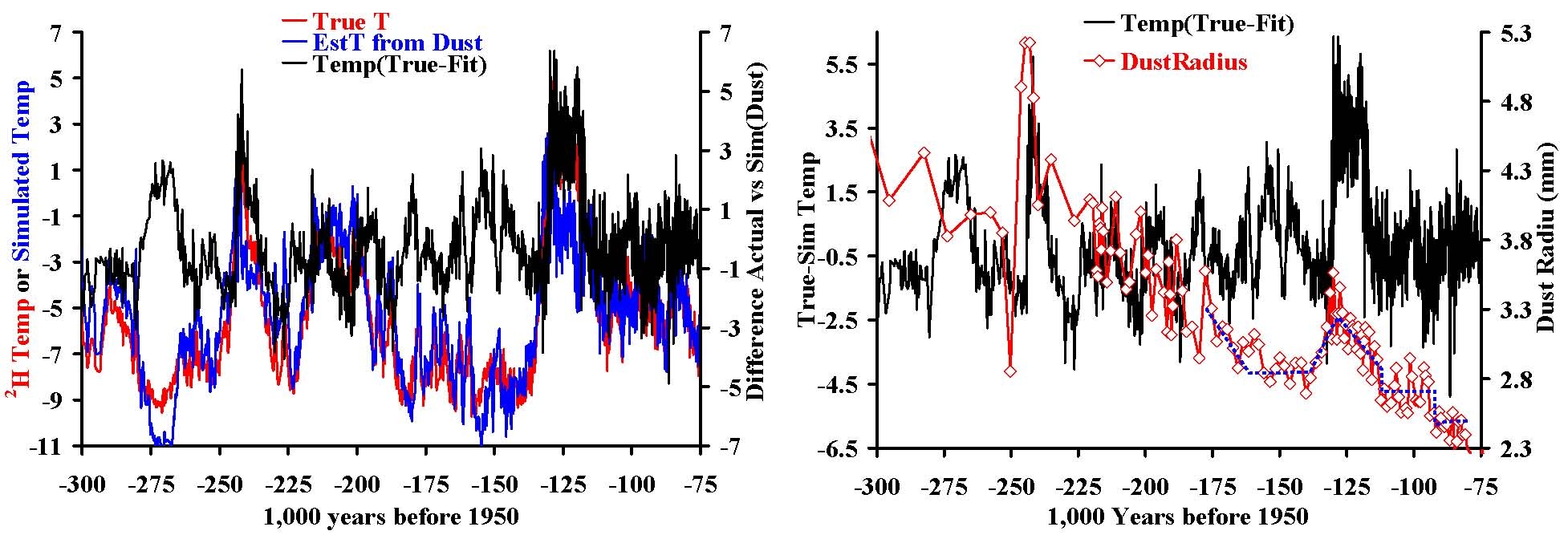
In Figure 2A, left, we show the actually temperature (red) reconstruction, simulated temperature (blue) and residuals (black), over the period 300,000 to 75,000 years ago. In Figure 2B, right, the same residual is plotted with the average radius of the dust particles, from the dust size determined by laser spectroscopy and archived by Durand, G. and J. Weiss. 2004 [9].
We do not know for certain what the size of dust particles actually was when dust particles were deposited on the ice. This is because dust size appears to be larger in the distant past compared with more recent times. We speculate that this may be due to compressive flocculation, where during compression of ice layers some dust particles become merged. What is clear is that older, deeper samples are on the whole larger than newer, upper dust. Despite the upward tend in dust size, fluctuations in the record are clearly visible. Even without correction for the gradual increases in dust particle size in deeper core samples, it is clear that larger dust particles is associated with higher temperature than smaller particles. The discontinuity between 130 and 116,000 years shows that larger particles underestimate the actual temperature in the simulation using the simple model; a similar blip is noticeable around 245,000 years.
Correlation is not causality (II). Dust composition
It is quite reasonable to suggest that the high levels of atmospheric dust found during periods of intense cold are a direct result of the Earth being cold. One could expect cooling to cause an increase in desertification, so increasing the levels of wind blown dust in the atmosphere. One could therefore presume that the correlations shown in Figures 1 and 2 are just a manifestation of a ‘cold = more desert = more dust’ phenomenon. However, elemental analysis of ice cores does not appear to support this argument. Work has been performed on the elemental and chemical composition of soluble and insoluble matter trapped in the Antarctic ice, but high resolution data is generally only available for the most recent 45,000 years. However, even this period can give us an insight into where the dust originated from. [10], [11]
Figure 3 shows eight different panels whereby changes in the deuterium derived temperature and dust levels (as -log10(Dust)), the insoluble dust radius and True Temp-Simulated Temp, the fraction changes in the levels of Fe and Cl, and finally the Cl/Na ratio and the Ca/Na ratio [the latter four elemental series from 10 and 11]. Each of the figures has been color coded to show seven different, distinct, periods; 45-40, 40-30, 30-27, 27-15, 15-11, 11-8 and 8-0 Ky.
The upper pair, Figures 3A and 3B, show that temperature changes generally track the –Log10(dust) levels, but there are distinct aberrations. In Figure 3C the True Temp minus Modeled Temp is presented next to the average dust radius during the same period, Figure 3D. Levels of Fe and Cl (normalized relative to present day values) are shown in panels 3E and 3F.
Figure 3. Changes in the Elemental composition of the Dome C ice core and effects on temperature.
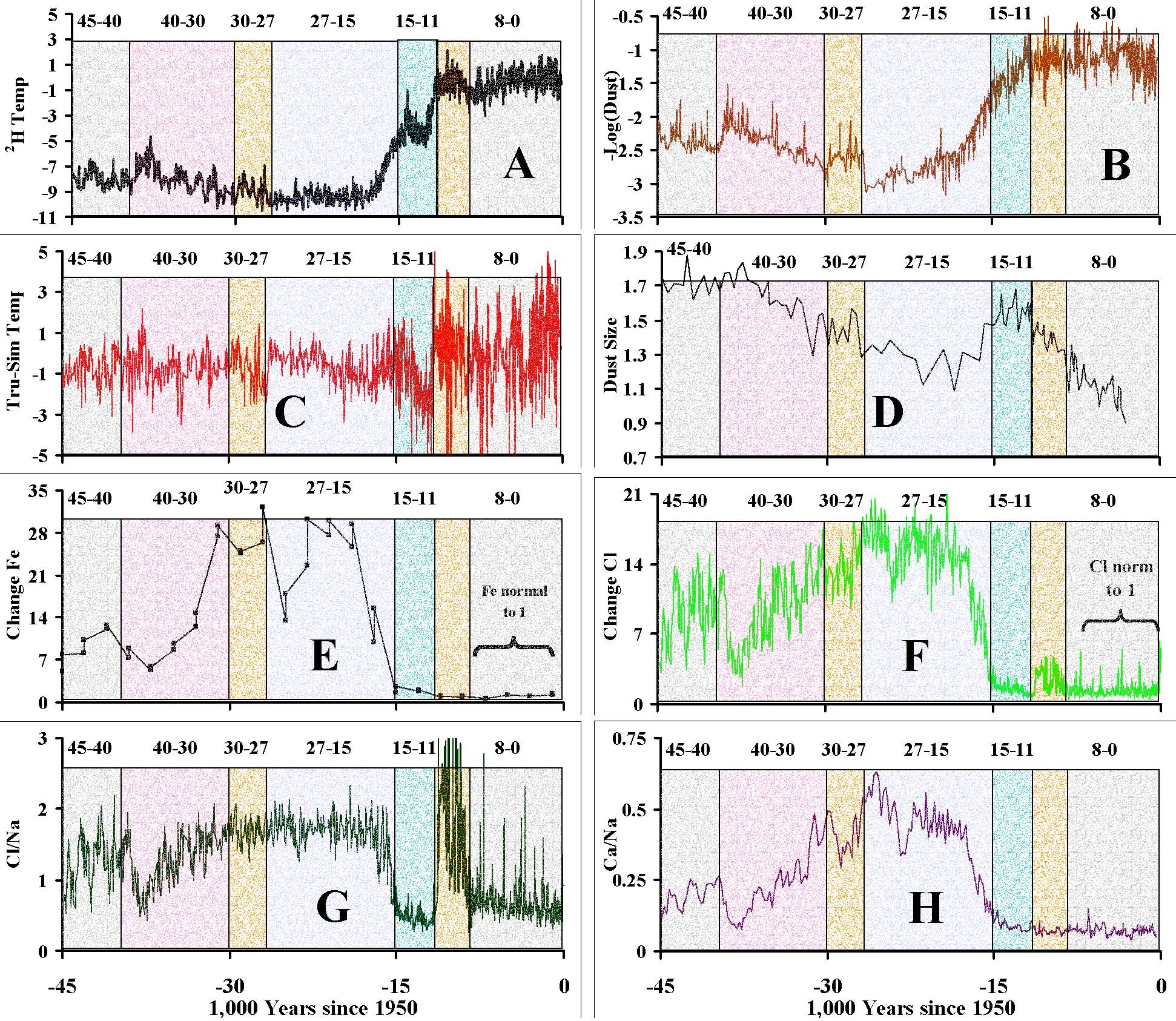
Finally, Figures 3G and 3H show the ratios of Cl/Na and Ca/Na. The Cl/Na ratio of sea salt is 55:31 or 1.78:1 and the calcium levels in sea water are low in comparison with the levels in soil, and therefore high Ca/Na ratios in Figure 3H, indicate the transport of material from land [12].
Sea Salt; 11-8 Ky. We observe a spike in sea salt in the period 11-8 Ky, indicated by a four fold increase in Cl, a Cl/Na ratio of approximately 2 (with spikes) and a low Ca/Na ratio. In this region, the modeled temperature is reasonably close to the true value.
The long Iron Age, 30-15 Ky. The Fe levels are high and stable from about 30 ky until they decline to twice present day levels at 15 Ky. In this period, we have a sea salt Cl/Na ratio, a land Ca/Na ratio, high Cl and high iron. At the same time, the dust particle size is very small. The Cl levels suggest sea salt, but the Ca/Na levels show that Na is not the counter ion to all the chloride. Moreover, insoluble dust is very high and particle size is very small. The levels of Fe, >30 times present day levels, suggest that the high levels of very small particles did not derive from either the land or from the oceans. This implies either volcanic or extraterrestrial sources. However, although not shown in Part (I), there is a drop in CO2 , and CO2 is a major emission from volcanic activity, indicating that volcanic activity is not the major dust source.
The post-Iron age; 15-11 Ky. Between 15-11 Ky we observe the biggest failure in the simple model of temperature as a function of dust levels in reproducing the actual temperature data. The dust levels fall in a bi-phasic fashion between 20 Ky and 8 Ky, to present day levels. The fall in Fe tracks an increase in dust particle size, in the way the rise in Fe levels tracked a fall in particle size. In Fe’s last gasp, between 15-11 Ky, there is a major failure in the model. In addition to the rise in particle size, Cl levels collapse, as does the Ca/Na and also the Cl/Na ratio. There is dust, but it is very poor in Fe, Cl, Na and Ca. The reason the model, Delta Temp = -5.3055*Log10(Dust ng/g), fails is that not all dust is the same. Size does indeed matter, as does composition.
Initial Conclusions
Global warming and cooling without greenhouse gases
In this initial presentation we have not examined the changes in the biotic atmospheric gasses, CO2, CH4, N2O, nor DMS/DMSO, during the glacial cycles of the last 800,000. In the next part of this series we will attempt to explain why these atmospheric levels of these biotic gasses fluctuated in the past, without recourse to the invocation of temperature.
Herein, we have presented evidence to support the postulate that global cooling during the ice age cycles observed over the last 800,000 years was associated with elevated atmospheric dust levels that reflected solar radiation. Comparing equal masses of dust, smaller particles are associated with more cooling than larger particles.
We find that there is no requirement to invoke ‘greenhouse gas’ driven mechanisms to explain the temperature changes that are recorded in the ice core record. Instead, we show that changes in the reflection/absorption of sunlight by atmospheric dust are plausible in both an historical sense, by correlation, and in terms of the basic physics of radiative transfer.
Where does the dust come from?
Examining the elemental composition of ice core, we speculate that the large levels of dust that are present in periods where the Earth is in the state know as Ice-ages, are of extraterrestrial origin. This postulate, and the periodicity of the ice-age/warm-age cycle, suggests that the solar system may regularly, every 80-82 thousand years, pass through Fe/Cl/Ca rich dust clouds.
.
“Dust thou art, and unto dust thou shalt return”
(Genesis 3:19)
.
About the author: DocMartyn is a classically trained biochemist/neurochemist who is currently working on novel therapeutic strategies for treating brain cancers and in the environment/genetic interactions that cause the autism phenotype. He was fortunate enough to be mentored by the worlds leading nitrogen oxides chemist and by one of the worlds best steady state modelers; although how much he was able to learn is open to debate. He has worked on the role of reactive oxygen species and reactive nitrogen species, including Fenton/Haber-Weiss Chemistry, in physiology and pathophysiology for 20 years. He has more than 50 peer reviewed papers and has four Patent Applications in various stages of advancement in the pipe.
JC comment: Last week Doc Martyn sent me an email with an initial version of this essay. I expressed my willingness to publish this at Climate Etc., but made a number of comments on the essay. The essay underwent several iterations. While I have gone through this essay carefully, I am unfamiliar with the primary literature on this topic. Hence my publishing this essay at Climate Etc. does not provide any endorsement of the analysis or the conclusions. I find this to be a very interesting topic, and my publishing this essay for open comment is part of my objective of attracting academics from outside the field of climate science to participate in climate science.
Moderation note: comments will be moderated for relevance.