

by Judith Curry
Mitigation, adaptation, and the threat to biodiversity.
Several years ago, Conservation Biology has published a paper with the provocative title Mitigation, adaptation, and the thread to biodiversity, by European biologists James Patterson, Miguel Araujo, Pam Berry, Jake Piper, Mark Rounsevell. Excerpts:
[W]ith the mounting recognition that mitigation and adaptation are vital for society comes a growing concern that biodiversity conservation will become an acceptable casualty in the fight against climate change. If the overriding priority is to preserve human welfare and prosperity at any cost, we foresee human actions compounding other threats to biodiversity. We argue that ultimately win–win–win goals should be sought, where mitigation and adaptation are considered on equal footing with biodiversity conservation. Opportunities for win–win–win solutions exist , but they are not pursued in many current and planned strategies (Fig. 1).
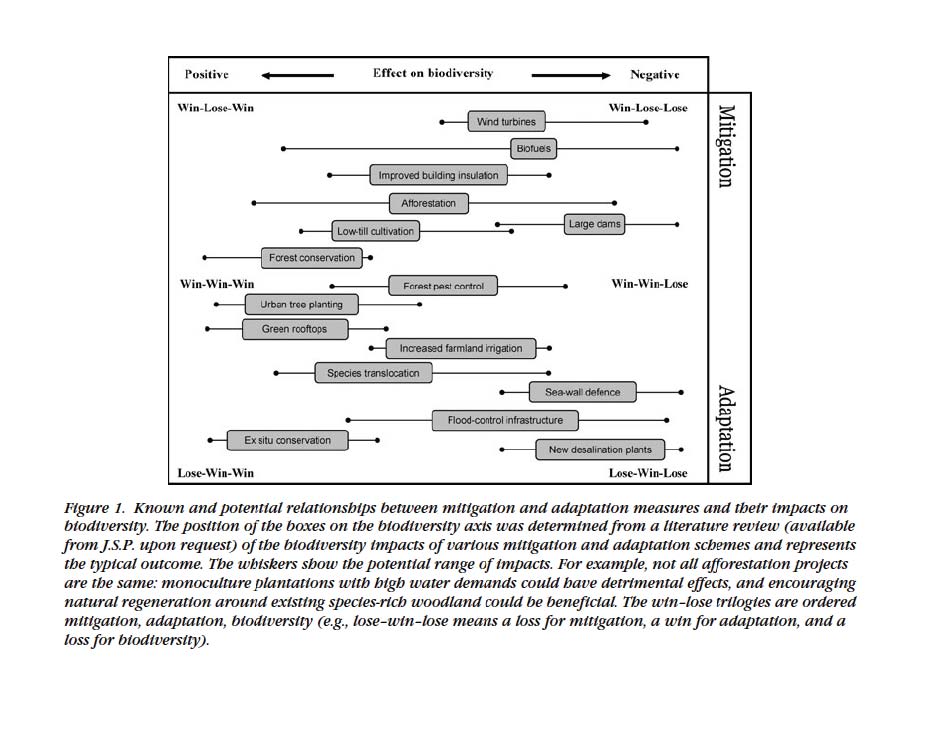
JC note: click on the figure to enlarge, this is a fascinating figure.
Thus far, adaptation has occurred in limited ways, and as a result, the majority of conflicts with biodiversity conservation stem from mitigation schemes.
In both examples governments are keen to see the projects implemented, not least because they will help in meeting carbon-reduction targets. The decisions to go ahead will hinge on whether they can circumvent the national and European conservation designations, which ultimately means that after an “appropriate assessment” is carried out, and if this is unfavourable, they will seek acceptance that there are “imperative reasons of overriding public interest” for the developments. The key is public interest, and the onus becomes to demonstrate that conserving biodiversity is in the public interest. But herein lies the problem: how can one convince decision makers that biodiversity is worth conserving? One approach is to adopt the ecosystem services paradigm. This concept employs a utilitarian valuation of all aspects of biodiversity and outlines the services or goods that are vital for human society. Although there has been little uptake of it in conservation planning and assessments thus far, the use of such a concept has considerable utility for conserving biodiversity.
Examples of win–win–win schemes do exist, however, and there are viable opportunities to apply this approach. Even the increasingly controversial bioenergy sector shows promise for producing low-input, high-biodiversity biomass on degraded soils. Perhaps the best example can be seen in forest management, and in particular, the conservation of biodiversity-rich forests. The promotion of carbon trading to preserve old-growth tropical forests from deforestation activities would have significant positive effects for mitigation (reducing one of the largest emissions of carbon to the atmosphere each year), adaptation (e.g., reducing floods and erosion), and biodiversity (protecting some of the richest ecosystems on Earth). Nevertheless, there are too many proposed schemes of other types (e.g., large dams) that could have detrimental effects on biodiversity. Until we recognize that conserving biodiversity is in the interest of local and global communities, the very schemes put in place to prolong our welfare and prosperity may, perversely, curtail them.
JC comments: This article is an important reminder that we need to consider the unintended consequences of climate change policy. Climate change mitigation/adaptation as an end in itself can lose sight of why we are even doing this in the first place: protection of ecosystem services would seem to be an important rationale for addressing climate change.
This article further highlights the wickedness of the climate change problem, as we contemplate and begin implementing climate change mitigation and adaptation policies.
And finally, identification of win-win strategies provides common ground so that individuals from a range of different constituencies can find reasons to support them.