by Judith Curry
On what we can learn from Goldilocks and The Three Bears regarding our perceptions of climate, climate science, communication and policy.
Continuing with the recent bear theme at Climate Etc., lets think about applications of the Goldilock’s principle to climate, climate science, communication and policy.
Goldilocks Principle
What is the Goldilocks Principle? From the Wikipedia:
The Goldilocks principle states that something must fall within certain margins, as opposed to reaching extremes. The Goldilocks principle is derived from a children’s story “The Three Bears” in which a little girl named Goldilocks finds a house owned by three bears. Each bear has their own preference of food, beds, etc. After testing each of the three items, Goldilocks determines that one of them is always too much in one extreme (too hot, too large, etc.), one is too much in the opposite extreme (too cold, too small, etc.), and one is “just right”.
My interest in the Goldilocks Principle was piqued by a presentation that I recently heard by Gary Flake entitled The Computational Beauty of Nature. It is a fascinating presentation, but I refer here specifically to slides 11 and 12:
Litmus tests:
Is it so simple that it’s boring, overly familiar, or simply uninteresting?
OR
Is it so unfamiliar as to seem random, intractable, obfuscated or even alien?
GOLDILOCKS PRINCIPLE
familiarity . . . novelty . . . surprise
stability . . . adaptability . . . flexibility
easy . . . ambitious . . . impossible
safety . . . opportunity . . . risk
order . . . meaning . . . chaos
THE MIDDLE MATTERS
The Goldilocks zone for climate
In planetary science, the ‘Goldilocks zone’ is terminology for the the band around a sun where temperatures are neither too hot nor too cold for liquid water to exist [link].
However, when it comes to planet Earth, we have a much narrower definition of the Goldilocks zone for climate. There is a youtube video entitled Goldilocks and the Greenhouse: the Science of Climate Change.
On the polar bear thread, Max Anacker writes:
We all know the fairy tale story of “Goldilocks and the three bears”, where GL enters the bears’ house (while they are all gone), snoops about and finds the “just right” chair, bowl of porridge and bed before being awakened by the returning bears and chased away.
Since this thread is about the Arctic, it should be pointed out that the “Blond Eskimos” (living between mainland Canada and Victoria Island) tell a similar tale:
http://en.wikipedia.org/wiki/Blond_Eskimos
Also of a little blonde girl (“niviasar”) and three bears – in this case, polar bears (“nanuks”), of course.
Their house is an igloo (what else?), the “just right” porridge she eats is made of ground seal pup mush but she is very hungry (“perlertok”), so this doesn’t matter, and when they awaken her, the little blonde Eskimo girl also manages to run away unscathed despite the nanuks’ carnivore instincts and inclinations.
Returning to science, climatologists have adopted the Goldilocks “just right” principle for our climate, with the premise that our climate was “just right” before humans started to interfere with it. It is already no longer “just right” and getting less so following an accelerated trend, due to human greenhouse gas emissions.
Some climatologists, suggest that the Goldilocks “just right” level of atmospheric CO2 was between 280 and 300 ppmv (19th century level) with anything over 450 ppmv (or even 350 ppmv!) no longer “just right” – but downright “dangerous”, in fact.
Fairy tales are nice, aren’t they?
Decadal scale climate amnesia and shifting baselines contribute to this ‘just right’ perception of the current climate.
There’s a recent book titled The Goldilocks Planet. From the blurb at amazon.com:
Climate change is a major topic of concern today and will be so for the foreseeable future, as predicted changes in global temperatures, rainfall, and sea level continue to take place. But as Jan Zalasiewicz and Mark Williams reveal in The Goldilocks Planet, the climatic changes we are experiencing today hardly compare to the changes the Earth has seen over the last 4.5 billion years.
And through all of this, the authors conclude, the Earth has remained perfectly habitable–in stark contrast to its planetary neighbors. Not too hot, not too cold; not too dry, not too wet–“the Goldilocks planet.”
Climate Science
On a previous thread, Donald Rapp describes the effect of the Goldilocks principle on climate science:
While many estimates have been made, the consensus value often used is ~3°C. Like the porridge in “The Three Bears”, this value is just right – not so great as to lack credibility, and not so small as to seem benign.
Huybers (2010) went on to say:
“More recently reported values of climate sensitivity have not deviated substantially. The implication is that the reported values of climate sensitivity are, in a sense, tuned to maintain accepted convention.”
Thus, they have imposed their preconceived notions of the expected temperature rise on the models to make them come out “right”. As we stated previously, this is like the Three Bears children’s story where the porridge was not too hot or too cold; the canonical 3°C temperature rise is large enough to be alarming, but small enough to be be credible.
Rapp’s argument echoes some of the broader issues raised by Thomas Kelly on confirmation basis, discussed on the previous thread Epistemology of Disagreement.
Communication and Policy
The Goldilocks Principle also suggests what is wrong with the alarmist/doom approach to communicating climate science and to motivating policy action. Climate doom seems alien and far away, or its inevitability makes mitigation seem intractable and hopeless.
Framing the challenge and the solution in terms of adaptability and opportunity, and ambitious rather than impossible, might feel ‘right’ in ways that alarmist motivated impossible policies do.
Dan Kahan has written an article entitled The ‘Goldilocks’ theory on public opinion on climate change. Excerpts:
We often are told that “dire news” on climate change provokes dissonance-driven resistance.
So one might infer that what’s needed is a “Goldilocks strategy” of science communication — one that conveys neither too much alarm nor too little but instead evokes just the right mix of fear and hope to coax the democratic process into rational engagement with the facts.
Inside Energy has a post entitled Goldilocks, Climate Legislation and Republican Engagement. Excerpts:
But, just as Goldilocks had to pursue a trial-and-error process, so does Congress in its search for that “just right” climate bill that will set in motion GHG reductions at the lowest cost. They obviously haven’t found it yet but having the Republicans constructively engaged in this testing is heartening.
The Middle Matters
So, does the Goldilocks Principle provide insights into the climate change debate? I think it does. The middle matters.
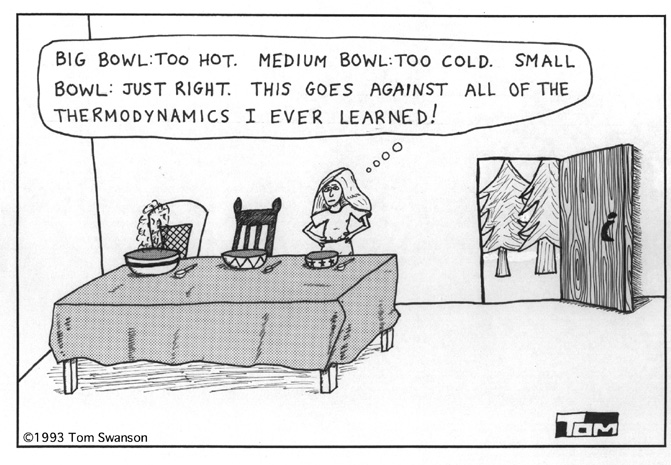
And finally, a cartoon. I think this Goldilocks cartoon is particularly apt: